
Locally owned and operated
About Water Damage Whittier
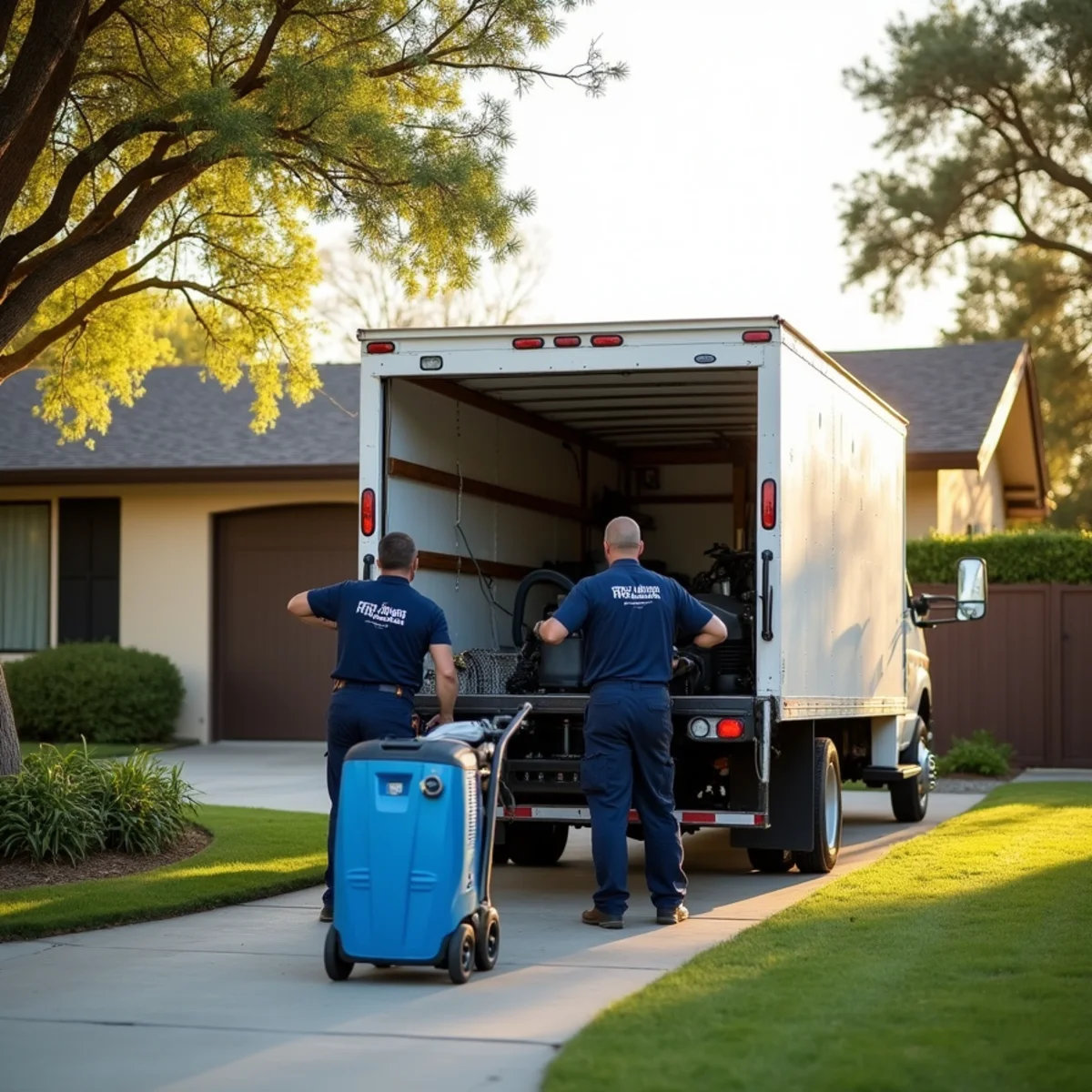
A Whittier-based water damage restoration crew. We answer our own phone, we drive our own trucks, and we carry jobs from the first extraction pass through to the final coat of paint.
- 24/7 emergency dispatch
- 60-minute target response
- IICRC-certified technicians
- Direct insurance billing
Why a local crew matters at 2 a.m.
Every restoration company in Los Angeles County advertises 24/7 service. The number that actually decides how your job goes is how long it takes a truck with extraction equipment on it to reach your address.
We work out of 7012 Walnut Grove Dr in east-central Whittier, near Whittwood Town Center. That is where the trucks are parked — which is why response to East Whittier, Whittwood and the Scott Avenue pocket is measured in single-digit minutes rather than in hours, and why our 60-minute target across the city is a real operational number rather than a slogan.
Being local also means knowing the buildings. The 1950s–70s slab-on-grade tracts that produce most of this city's slab leaks. The galvanized supply still in service across West Whittier and Michigan Park. The lath-and-plaster and original hardwood around Whittier College, which needs a slower drying plan and a crew that will not reach for the demolition saw on day one. A technician who has opened fifty of these houses knows where the manifold runs and where the water tends to surface, and that shortens the diagnostic phase — which is exactly where hidden moisture gets missed.
What we handle
The full arc of a water loss: emergency extraction, structural drying, contaminated water cleanup, mold remediation, leak detection, and the reconstruction that puts the property back — drywall, texture, paint, flooring, baseboard and cabinetry.
Keeping mitigation and rebuild under one roof matters more than it sounds. When they are two companies, nobody owns the handoff, the two scopes never quite reconcile on the claim, and you become the project manager during the worst week of your year.
Certifications and insurance
Our technicians are IICRC certified — the industry standard for restoration training, covering the protocols for extraction, drying and remediation that this work is measured against. We are insured, and we bill your carrier directly on covered claims.
Certification and license numbers are available on request, and we would encourage you to ask us — and to ask any other company you are considering.
How we work
Our Standards, Written Down
Hold us to these. They are also a reasonable checklist for judging anyone else you call.
We inspect before we quote
Every time. A firm number over the phone without thermal imaging and moisture readings is either padded to be safe or low enough to win the job and grow later. Neither helps you.
We map the whole wet footprint
Not the visible edge of the water. Thermal imaging and meters find what has traveled under flooring, into wall bases and behind cabinetry — which is nearly always more than the puddle suggests.
We dry in place wherever the readings allow
Cavity drying through small hidden access points, mat drying systems for solid hardwood, slower controlled drying for plaster. Removal is a last resort, because original material cannot be bought back.
We log readings daily and hand them over
Same marked locations, same meters, every day, in writing. That log is what ends the job on time and what answers an adjuster who questions the drying days.
We give honest arrival windows
Including the ones you do not want to hear. During a major storm every crew in the county is deployed, and a company promising an hour to every address is describing marketing rather than logistics.
We tell you when you do not need us
Some things are a plumber, a roofer or a two-minute meter test you can run yourself. We would rather say that than sell a visit.
What is on the truck
The equipment, and what each part is actually for
Restoration is a measurement trade before it is a drying trade. Half of this list exists to find water and prove it has gone; the other half exists to move it. Knowing which is which is a fair way to judge any company that turns up at your door.
- Thermal imaging camera
- Finds temperature anomalies behind finishes, which is how hidden moisture is located without opening anything. It is a pointing tool rather than proof — every indication gets confirmed with a meter before we act on it.
- Penetrating and non-invasive meters
- The non-invasive meter sweeps large areas fast; the penetrating meter reads inside framing, subfloor and wall cavities. Both are read against a dry standard taken from unaffected material in the same house.
- Weighted extraction tools
- Body weight is driven through the head to compress carpet and padding while vacuuming, pulling water the pad would otherwise hold. The recovered volume against a shop vac on the same carpet is not a close comparison.
- Low-grain refrigerant dehumidifiers
- These pull moisture out of air that is already fairly dry, which is what a sealed drying chamber becomes after the first day. Undersize this and evaporation stalls no matter how many fans are running.
- Air movers and cavity drying systems
- Air movers create evaporation across surfaces. Cavity systems inject air through small hidden access points into wall bases, toe kicks and under flooring — the enclosed voids that room airflow never reaches.
- HEPA filtration and negative air
- Containment barriers with HEPA-filtered negative pressure, used on contaminated water and any remediation work. It keeps what is being disturbed inside the work area instead of distributed through the house.
Straight answers on the things we do not control
Every restoration company has the same four constraints. Most of them are quiet about it until the constraint bites, which is when a homeowner who was promised something specific starts feeling misled. We would rather set the expectation now — the same reason our reviews page explains what we will and will not publish.
Ask us anything on the phoneArrival time is a target, not a guarantee
We aim for 60 minutes across most of Whittier and usually beat it close to base. During the first big storm of the season, every crew in the county is deployed. You will get a real window and an update if it moves.
Drying takes as long as the materials take
Carpet over slab is three to four days. Solid hardwood, plaster and a saturated slab are not, and no amount of extra equipment changes physics past a point. We can tell you the likely number on day one and then show you the readings.
Coverage decisions belong to your carrier
We document cause, category, extent and every drying day so your claim rests on evidence rather than opinion — and that genuinely changes outcomes. What we cannot do is decide the claim, and any company implying otherwise is overselling.
We will not quote a firm price sight unseen
Not over the phone, not before the affected area has been mapped with a meter. A number given at that stage is either padded or destined to be revised, and both damage trust at exactly the wrong moment.
Questions people ask before hiring us
Are you actually based in Whittier, or is this a dispatch service?
Do the same people do the drying and the rebuild?
What certifications do your technicians hold?
How many jobs do you run at once, and will my job get a full crew?
What happens if I am not happy with the work?
Local proof
What Whittier Customers Say
We publish customer reviews as jobs close, with the customer's first name, their neighborhood and what the job actually involved — not invented quotes. Until those are here, judge us on things you can verify on the phone in two minutes:
- A person answers the emergency line — not an answering service taking a message
- A 60-minute target response across Whittier, with an honest arrival window on the call
- IICRC-certified technicians, and a certification number available on request
- Direct insurance billing, with daily moisture readings supplied in writing
- We inspect with thermal imaging and moisture meters before we quote — never a phone price
- Mitigation and rebuild under one roof, so there is one set of documentation
Already worked with us? Leave a review on our Google listing — it genuinely helps other Whittier homeowners find a local crew.
Service area
Where we work
Our core service area, with full coverage across the Gateway Cities and lower San Gabriel Valley beyond it.
- East WhittierUnder 10 minutes from our Walnut Grove Dr base. This is our home zone.
- Uptown WhittierAbout 8 to 12 minutes from our Walnut Grove Dr base, west along Whittier Boulevard or Philadelphia Street.
- Whittwood, WhittierUnder 10 minutes from our Walnut Grove Dr base — one of our closest zones.
- Friendly Hills, WhittierAround 8 to 12 minutes from our base, up toward the Whittier foothills.
- Pico RiveraTypically 10 to 15 minutes from our Walnut Grove Dr base, straight across on Whittier Boulevard or Washington Boulevard.
- Santa Fe SpringsAround 10 minutes from our base, south on Painter Avenue or straight down the 605.
- South WhittierUsually under 10 minutes from our Walnut Grove Dr base — one of the fastest zones we serve.
- La MiradaRoughly 12 to 18 minutes from our Whittier base via Imperial Highway or Rosecrans Avenue.
- NorwalkAround 12 to 15 minutes from our base, south on Norwalk Boulevard or Pioneer Boulevard.
- Los Angeles CountyWe work the southeast quadrant of the county from our base at 7012 Walnut Grove Dr in Whittier, with a 60-minute target response across the Gateway Cities and the lower San Gabriel Valley.
Water Damage Whittier7012 Walnut Grove Dr, Whittier, CA 90606Open 24 hours — 7 days a week, including holidays