
Water Damage Restoration · Whittier, CA
Flood Cleanup Services in Whittier, CA
Storm and overflow flooding handled as the contaminated-water event it is — extraction, removal, disinfection, drying.
- 24/7 emergency dispatch
- 60-minute target response
- IICRC-certified technicians
- Direct insurance billing
Flood water is not the same as a burst pipe, and treating it the same way is how people get sick.
Water that has crossed the ground before entering your home picks up whatever it crossed: fertilizer and pesticide from lawns, oil and brake dust from the street, whatever was in the storm drain, and bacteria from soil and animal waste. Under industry standards that makes it Category 3 — grossly contaminated. Porous materials that absorbed it do not get dried and put back. They get removed and replaced.
That sounds severe. It is also the difference between a home that is genuinely clean afterward and one that smells wrong every humid week for the next five years.
What you actually get
What Flood Cleanup Covers
Flood work is a contaminated-water scope from the first minute. Everything below is standard on our jobs, not an upsell discovered on day three.
Category 3 protocol from the outset
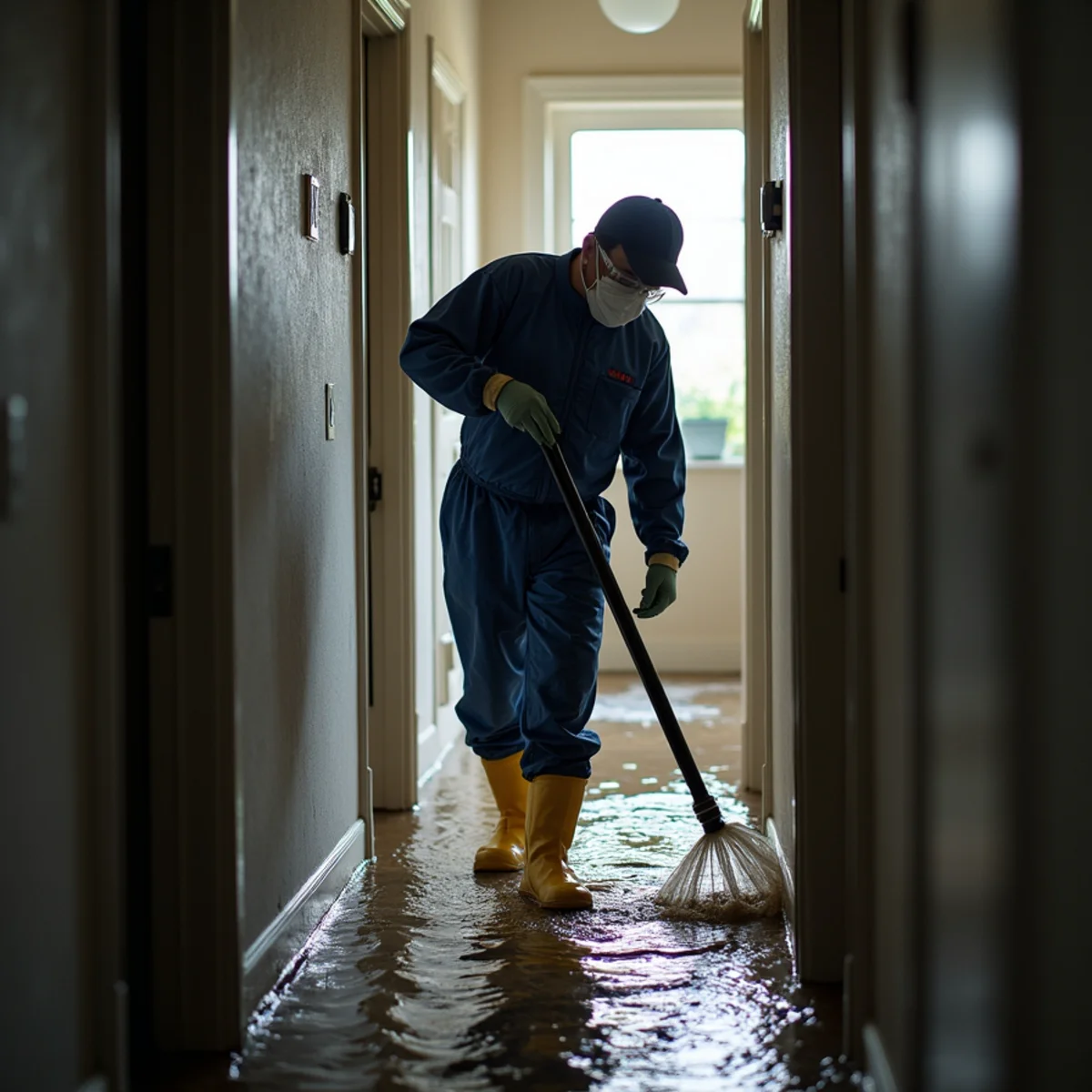
Crews in full protective equipment, containment where it is needed, and dedicated equipment that is not shared with clean-water work.
Water, silt and debris removal
Pump and extraction for the water, then mechanical removal of the mud and sediment storm flooding leaves behind on floors and in crawl spaces.
Flood cuts and porous removal
Carpet, pad, wet insulation and drywall cut to a documented height above the water line, because paper facing wicks higher than the visible stain.
Clean, then disinfect
Physical removal of soil load first — antimicrobial on a dirty surface does very little — then treatment with proper dwell time.
Crawl space vapor barrier
Contaminated barrier removed and replaced, saturated batt insulation taken out, and the soil treated where the water category warrants it.
Source documentation for your claim
Entry point and water source photographed in detail, because flood coverage turns entirely on where the water came from.
Why Whittier Floods the Way It Does
This part of Los Angeles County is heavily channelized, and that shapes local flood behavior. The San Gabriel River runs in a concrete channel along the east side of the service area, the Rio Hondo to the west, and the Los Angeles County Flood Control District operates Whittier Narrows Dam and its spreading grounds upstream. Those systems move an enormous volume of storm runoff away from neighborhoods that would otherwise take it.
What they do not do is manage water once it is already on your street. Whittier gets roughly 14 inches of rain a year, delivered almost entirely between November and March and increasingly in concentrated atmospheric river events rather than steady drizzle. When two inches falls in six hours, the limiting factor is not the river channel — it is the storm drain at the end of your block, the grade of your driveway, and whether the yard drains you have not cleaned since spring are open.
That is why the flood calls we take cluster in specific conditions: the first big storm after a dry autumn, when gutters and drains are full of leaf litter; and the third or fourth day of a sustained system, when soil is saturated and there is nowhere left for water to go.
What Gets Saved and What Does Not
This conversation happens early, and being straight about it is part of the job.
Removed: carpet and padding, laminate and engineered flooring that has swelled, wet insulation, particle-board furniture and cabinet bases, and the lower section of drywall that wicked contaminated water. Drywall is typically cut two feet above the high water line — a flood cut — because the paper facing draws water higher than the visible stain.
Usually saved: framing, solid wood, concrete slab, tile, metal, and hard surfaces generally. These get cleaned, disinfected, and dried rather than replaced. Case by case: solid hardwood flooring, upholstered furniture, and stored contents. If it can be cleaned to a sanitary condition and dried without distortion, it stays.
Sentimental items — photographs, documents, textiles — should not be thrown out before we look at them. Some of it is recoverable with specialty drying even after full submersion. Set them aside somewhere cool and tell us they matter.
Disinfection Is a Separate Step
After removal and before drying, affected hard surfaces are cleaned and treated with an appropriate antimicrobial. Order matters: disinfecting a surface that still has silt and organic debris on it accomplishes very little, so cleaning comes first, then treatment, then drying.
Crawl spaces and subfloor areas get particular attention, because that is where flood water goes and stays. In raised-foundation homes around West Whittier-Los Nietos and older parts of Pico Rivera, we are often removing saturated batt insulation and replacing vapor barrier as part of the flood scope, not as an add-on.
Why us for this job
Why Storm Flooding Needs a Crew That Does This Properly
Flood water is the one category where cutting the protocol short does not just cost money later — it leaves a house that is not sanitary.
We treat ground-contact water as contaminated
Regardless of how clear it looks. Water that crossed a street, a lawn or an industrial parcel carries what it crossed, and porous materials that absorbed it are removed.
We know the local flood mechanism
The river channels handle the river. What reaches Whittier houses is storm drain capacity, driveway grade and blocked area drains — the channel protects at regional scale but not at lot scale, and that changes where we look for entry.
Crawl spaces are in scope, not extra
Raised-foundation homes across the older neighborhoods take flood water underneath, where it sits with no drainage and no airflow until someone pumps it.
We document the source, not just the damage
Standard policies exclude flood from outside. If your loss is actually a covered internal failure, the evidence for that has to be gathered on day one. For properties near the basin, the risk worth planning for is local drainage rather than the dam itself.
- IICRC-certified technicians
- Licensed & insured
- 60-minute target response across Whittier
- Direct insurance billing
- 7012 Walnut Grove Dr, Whittier, CA 90606
Need flood cleanup today?
Ground-contact water is contaminated until proven otherwise — call before anyone starts moving contents.
Step by step
Our Flood Cleanup Process
Contaminated-water protocol from the first minute — PPE, containment, disposal documentation.
Step 1
Safety and assessment
Electrical hazards checked, structural stability assessed, contamination level established. Crews work in appropriate PPE from the outset rather than upgrading halfway through.
Step 2
Water and solids removal
Pump and extraction equipment removes the water; silt, mud and debris that storm flooding leaves behind are removed mechanically before anything else happens.
Step 3
Controlled demolition
Carpet, pad, wet insulation and flood-cut drywall come out and are bagged and documented for disposal. Everything removed is photographed for your claim before it leaves the property.
Step 4
Clean and disinfect
Remaining structure is cleaned of soil and organic load, then treated with antimicrobial. Crawl space vapor barrier is replaced where it was contaminated.
Step 5
Dry and verify
Full structural drying with daily monitoring, then documented clearance readings before any rebuild begins.
On the job
Honest pricing
What Flood Cleanup Costs Depend On
Flood work costs more than clean-water work at the same square footage, and it is worth understanding why.
- Contamination level
- Category 3 protocol adds PPE, containment, regulated disposal and mandatory material removal.
- Volume of material removed
- Carpet, pad, insulation and flood-cut drywall are disposal weight, and disposal is billed by weight and volume.
- Silt and debris load
- Storm flooding leaves solids behind. Mechanical cleanup of mud and sediment is labor-intensive.
- Crawl space involvement
- Confined-space work is slower, and vapor barrier and insulation replacement are usually part of the scope.
- Rebuild extent
- Flood cuts mean drywall, insulation, baseboard, paint and flooring across the affected perimeter.
Important coverage note: standard homeowners policies generally exclude flooding from external sources. Sudden internal failures are usually covered; rising water usually is not, unless you carry separate flood insurance. We document the source carefully either way — see flood insurance vs. homeowners insurance.
Related services, service areas and guides
Related services
- Storm Damage CleanupEmergency tarping and board-up first, then extraction and drying — so the next band of rain does not undo the work.
- Sewage Cleanup & Backup RemovalBlack-water backups removed under full containment, then disinfected, deodorized and dried to a verified sanitary condition.
- Water Extraction & RemovalTruck-mounted and portable extraction that pulls water out of carpet, pad and subfloor before it reaches the framing.
Related reading
- Stormwater Got Inside: What's Salvageable After a Flood and What Isn'tPorous keeps water and contamination inside it. Non-porous does not. Almost every keep-or-toss decision follows from that one distinction.
- Category 1, 2, or 3? Why the Type of Floodwater Changes the Entire CleanupThe first question the dispatcher asks is where the water came from. It determines the protocol, the protective equipment, and what you get to keep.
Flood Cleanup across our service area
We provide flood cleanup across Whittier and the surrounding Los Angeles County communities. Each area page covers the local housing and drainage risks that actually drive water damage there.
- East WhittierUnder 10 minutes from our Walnut Grove Dr base. This is our home zone.
- Uptown WhittierAbout 8 to 12 minutes from our Walnut Grove Dr base, west along Whittier Boulevard or Philadelphia Street.
- Whittwood, WhittierUnder 10 minutes from our Walnut Grove Dr base — one of our closest zones.
- Friendly Hills, WhittierAround 8 to 12 minutes from our base, up toward the Whittier foothills.
- Pico RiveraTypically 10 to 15 minutes from our Walnut Grove Dr base, straight across on Whittier Boulevard or Washington Boulevard.
- Santa Fe SpringsAround 10 minutes from our base, south on Painter Avenue or straight down the 605.
- South WhittierUsually under 10 minutes from our Walnut Grove Dr base — one of the fastest zones we serve.
- La MiradaRoughly 12 to 18 minutes from our Whittier base via Imperial Highway or Rosecrans Avenue.
- NorwalkAround 12 to 15 minutes from our base, south on Norwalk Boulevard or Pioneer Boulevard.
- Los Angeles CountyWe work the southeast quadrant of the county from our base at 7012 Walnut Grove Dr in Whittier, with a 60-minute target response across the Gateway Cities and the lower San Gabriel Valley.
Request a visit
Free Estimate for Flood Cleanup
We inspect with thermal imaging and moisture meters before quoting — a firm price given over the phone without readings is a guess. If water is spreading right now, call instead; crews are dispatched during the conversation.
+1 (201) 277-9344