
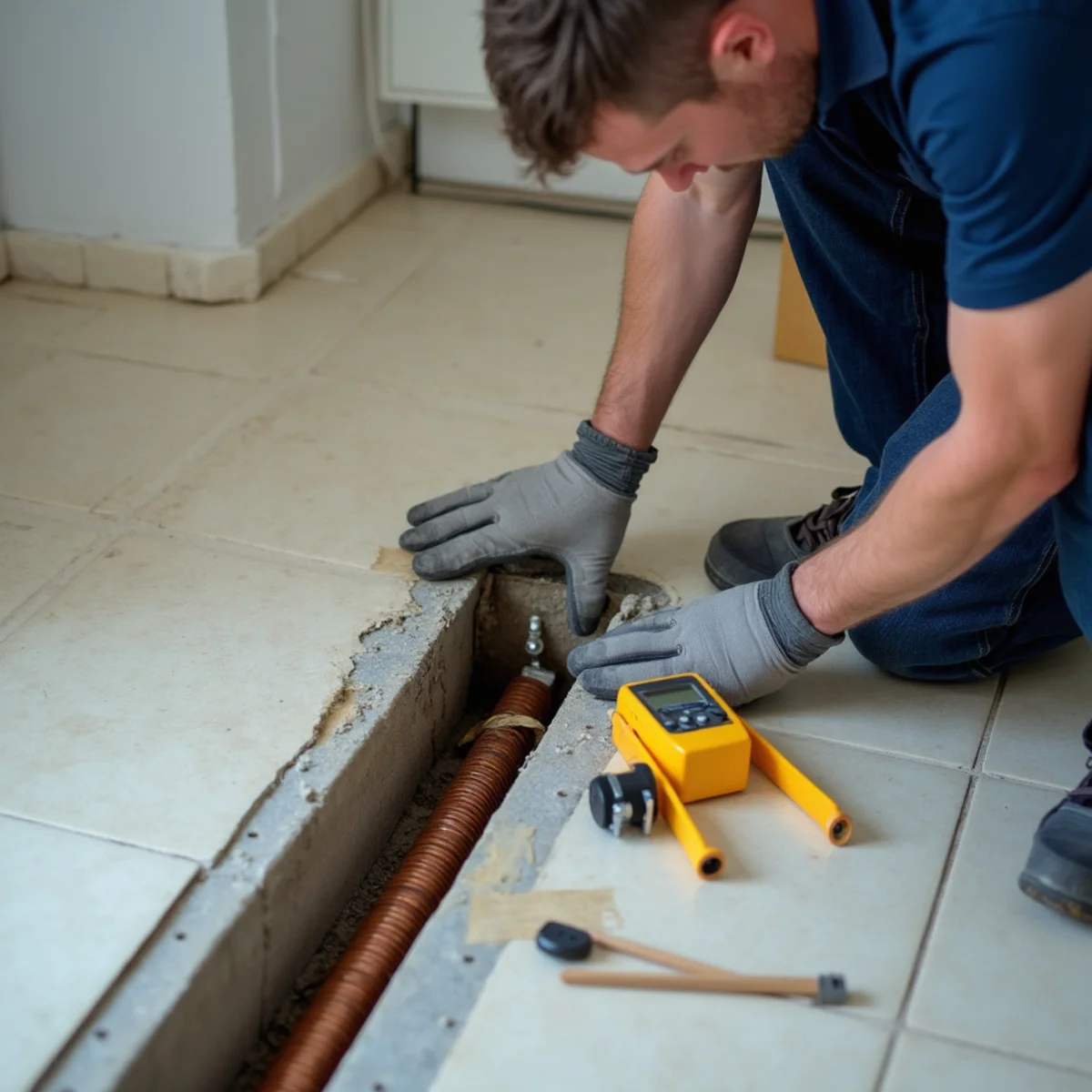
Water Damage Restoration · Whittier, CA
Slab Leak Water Damage Restoration in Whittier, CA
The most common serious water loss in Whittier — located precisely, dried through the slab, and restored properly.
- 24/7 emergency dispatch
- 60-minute target response
- IICRC-certified technicians
- Direct insurance billing
If you own a Whittier home built between about 1950 and 1980, this is the water loss most likely to happen to you.
A slab leak is a failure in a pressurized supply line running under or within the concrete foundation. Because the pipe is encased, the water has one direction to go: sideways. It spreads across the slab under your flooring, wicks into the bottom plate of the wall framing, and surfaces days or weeks later somewhere that looks unrelated to the actual break.
The reason it is such a local problem is simply construction history. This city built out in slab-on-grade tracts through exactly the decades when galvanized steel and soft copper were the standard supply materials — and both have now reached the age where failure is routine.
What you actually get
What Slab Leak Restoration Includes
The plumbing repair is one line. What this scope covers is everything the water did on its way out, and getting the slab ready to take flooring again.
Precise leak location
Acoustic, thermal and pressure isolation narrowing the break to inches — because every inch of vagueness becomes a foot of opened concrete.
Full moisture mapping
How far water has traveled under the flooring and up the wall base, which on a slab leak is nearly always wider than the homeowner expects.
Repair coordination
Spot repair, reroute or repipe sequenced with a licensed plumber so restoration follows immediately rather than weeks later.
Flooring lift and cabinetry access
Affected flooring lifted where readings require it, and toe kicks and cabinet bases opened where water has collected in the voids.
Slab moisture testing
In-situ relative humidity probes or calcium chloride testing — a surface meter reading is not enough to clear concrete for new flooring.
Reinstatement once the slab is in tolerance
Flooring, drywall, baseboard and cabinetry restored only after the concrete tests within spec for the covering going back over it.
Why Whittier Slabs Leak
Two materials, two distinct failure mechanisms, both age-driven.
Galvanized steel, standard in earlier post-war construction, corrodes from the inside. Scale builds up, the internal diameter shrinks, pressure drops across the house, and the pipe eventually fails at a threaded joint where the wall is thinnest. Homes in Michigan Park, Orange Drive and older parts of West Whittier still have plenty of it in service.
Copper, standard from roughly the 1960s onward, fails through pitting corrosion — small pinholes eaten from the inside out. Los Angeles County water is hard, and water chemistry, mineral content and decades of flow all contribute to pitting. The tracts across East Whittier, Sorensen Park and South Whittier are squarely in the copper era and squarely in the pinhole window.
Add soil movement. Expansive clay-loam soils across parts of the service area swell when wet and shrink when dry, and that seasonal cycle puts stress on both the slab and anything cast into it. It rarely causes a leak on its own. It reliably accelerates one.
What the Water Does Under Your Floor
Damage from a slab leak is unusual in that most of it happens invisibly, over weeks.
Water spreads laterally across the top of the slab beneath the flooring, or through the soil beneath the slab if the break is lower. Under tile with a solid mortar bed, it can travel a long way with almost no surface sign. Under vinyl plank or laminate it collects against the underside and cannot escape upward, which is why those floors buckle apparently overnight after weeks of quiet saturation.
It wicks into the bottom plate of the wall framing and up the drywall by capillary action — commonly eight to sixteen inches. It gets into cabinet toe kicks. And in the soil beneath, a long-running leak can wash out fines and create voids, which is the mechanism behind the slab cracking and settlement that turns a plumbing problem into a foundation conversation.
This is why a slab leak found in week one and a slab leak found in month four are completely different jobs.
Repair Options — and Which One Is Right
The pipe repair is licensed plumbing work; we coordinate it and handle everything the water did. There are three realistic paths and the choice matters.
Spot repair. Open the slab at the located point, repair the pipe, patch the concrete. Least disruptive, lowest cost, correct choice for an isolated failure in otherwise healthy pipe. It does nothing for the rest of the line.
Reroute. Abandon the under-slab section and run a new line overhead through the attic or through walls. No further slab work at that location ever, at the cost of opening walls and ceilings for the new run. Often the sensible middle path for a second failure.
Repipe. Replace the supply system throughout with PEX or copper. Highest cost and most disruption, and the only option that actually ends the problem when the pipe material has reached end of life across the whole house. If you have had three failures in a few years, you are already paying for a repipe — just in installments, each with emergency restoration attached.
Our restoration scope is the same regardless of which path you take: dry the slab and the affected assemblies, remove what cannot be dried, and rebuild the flooring, drywall and cabinetry that had to be opened.
Drying a Slab Is Slower Than Drying a Wall
Concrete holds moisture and gives it up slowly. That has consequences for the schedule and for the rebuild.
After the repair, the slab itself has to come down to an acceptable moisture level before new flooring goes back over it — otherwise the slab keeps pushing vapor upward into your new floor and the adhesive, and you get failure in the new material within a year. This is measured with in-situ relative humidity probes or calcium chloride testing rather than a surface meter reading.
Expect longer equipment time on a slab job than on an equivalent above-grade loss, and be skeptical of any contractor who wants to lay flooring the week after the plumbing repair. The waiting is the job.
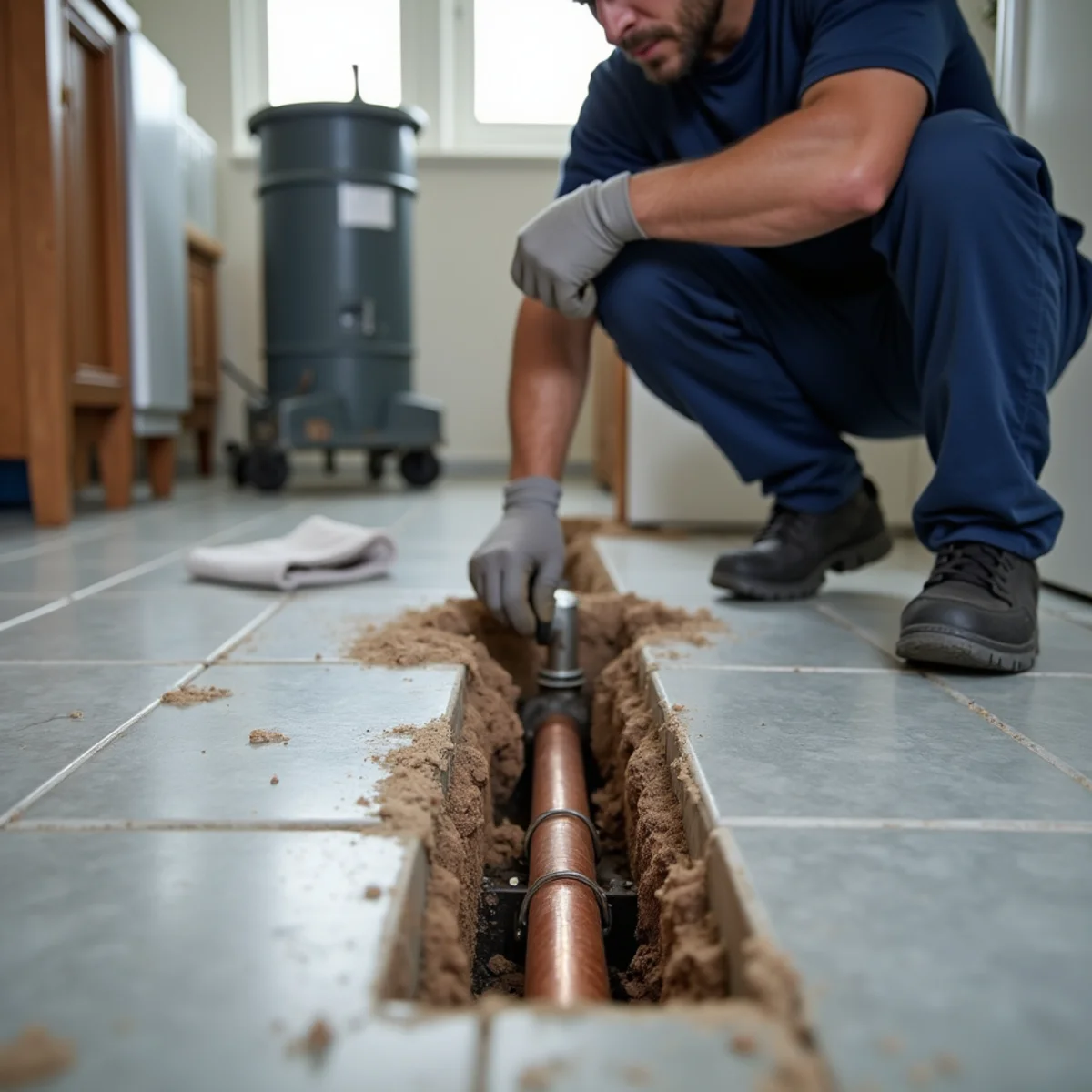
Why us for this job
Why Slab Leaks Are the Job We Do Most
This is the single most common serious water loss in Whittier, and the one where a generic crew costs you the most.
We work these tracts constantly
East Whittier, Sorensen Park, Michigan Park, South Whittier. Knowing how a tract was plumbed shortens the diagnostic, and the diagnostic is where hidden moisture gets missed.
We will not lay flooring over a wet slab
Concrete releases moisture slowly and pushes it back into new flooring for months. Be skeptical of anyone wanting to install the week after the plumbing repair.
We explain the repair options honestly
Spot repair, reroute or repipe each carry a different restoration footprint. We tell you what we saw in the pipe so the choice is informed.
We know what the policy covers
Most California policies pay the resulting damage and reasonable access, and exclude the pipe itself. Documenting to that distinction is how the claim gets paid.
- IICRC-certified technicians
- Licensed & insured
- 60-minute target response across Whittier
- Direct insurance billing
- 7012 Walnut Grove Dr, Whittier, CA 90606
Need slab leak water damage restoration today?
A warm patch on the floor is weeks old by the time you notice — call and we will locate it precisely.
Step by step
Our Slab Leak Restoration Process
Locate, coordinate, dry, rebuild — with slab moisture verified before any flooring goes back.
Step 1
Confirm and locate
Meter test to confirm active loss, then acoustic listening, thermal imaging and pressure isolation to pinpoint the break — see leak detection.
Step 2
Map the damage
Moisture mapping establishes how far water has traveled under flooring and up the wall base. This footprint is nearly always larger than the homeowner expects.
Step 3
Coordinate the repair
Spot repair, reroute or repipe, performed by a licensed plumber, sequenced so restoration follows immediately rather than weeks later.
Step 4
Dry the slab and structure
Affected flooring lifted where required, wall cavities dried through controlled access points, and the slab dried and monitored with proper moisture testing.
Step 5
Verify, then rebuild
Slab moisture confirmed within tolerance for the new floor covering, then flooring, drywall, baseboard and cabinetry restored.
On the job
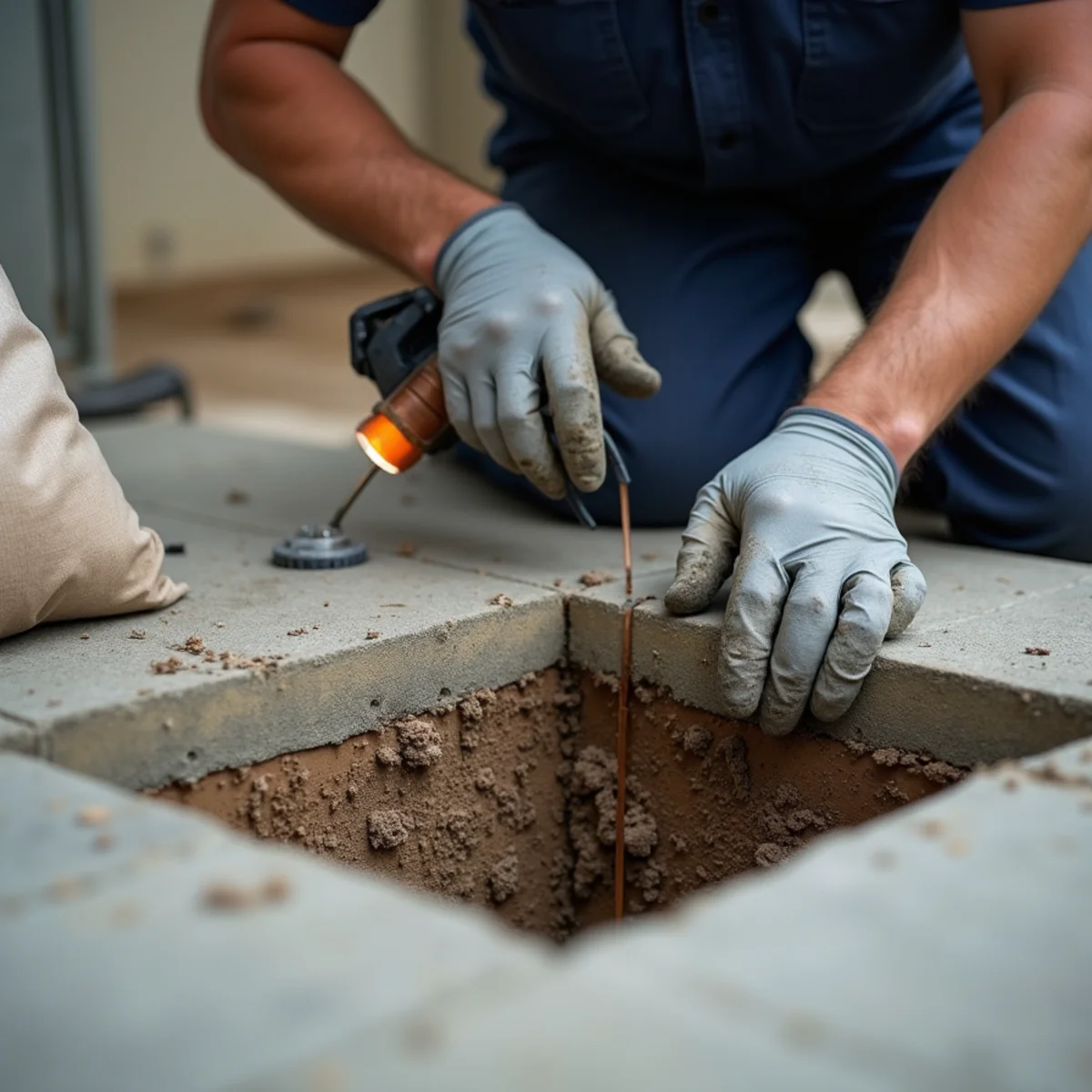
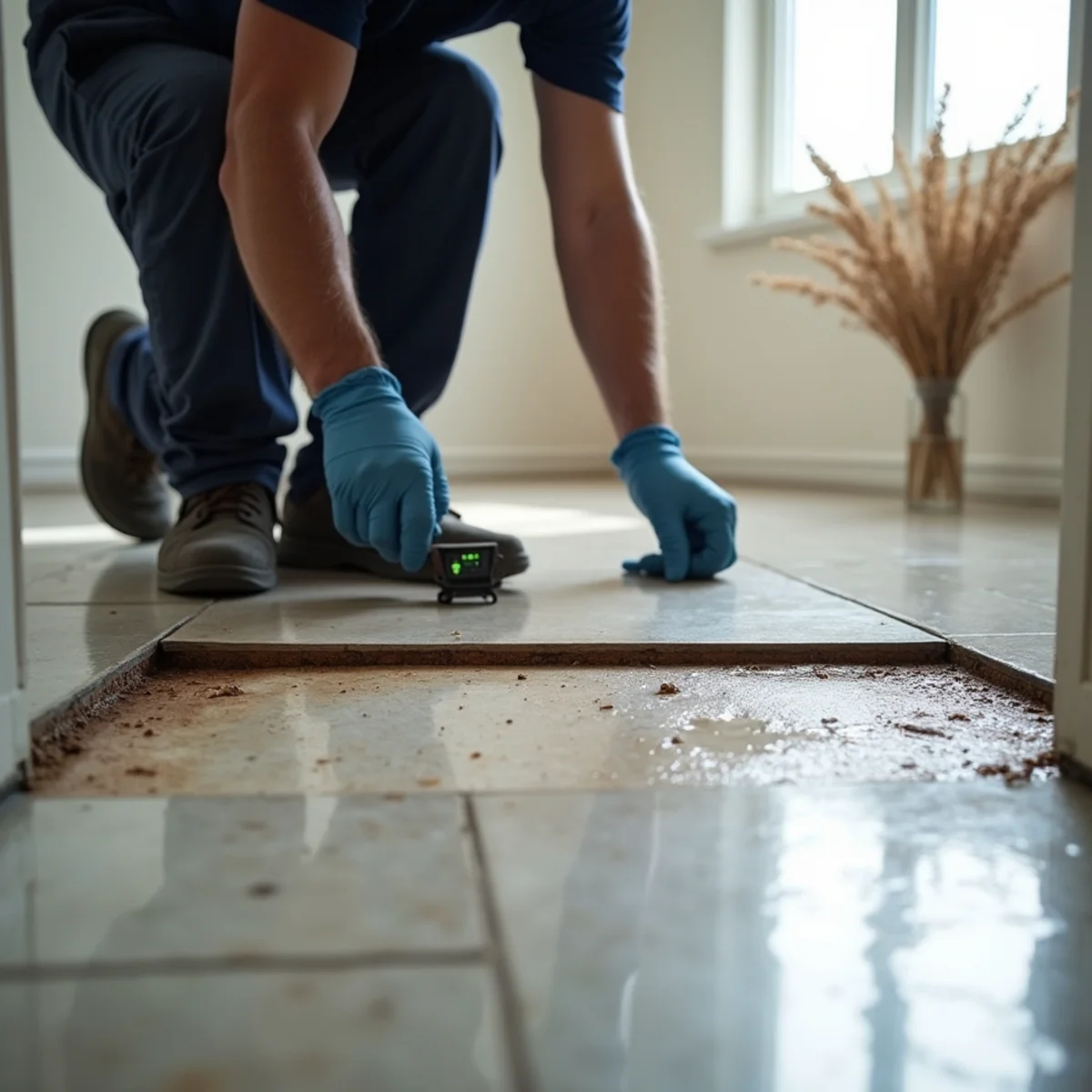
Honest pricing
What Slab Leak Restoration Costs Depend On
Restoration cost is driven by how far the water traveled, not by the size of the hole in the pipe.
- How long it ran undetected
- The single largest variable. Weeks of quiet saturation means flooring, wall base and cabinetry rather than a single room.
- Flooring type over the slab
- Tile in a mortar bed is expensive to remove and reinstate. Carpet is cheap. Laminate and engineered wood almost always need full replacement.
- Repair method chosen
- Spot repair, reroute through walls and attic, or full repipe — each carries a different restoration footprint.
- Slab drying time
- Concrete releases moisture slowly, and new flooring cannot be installed until the slab tests within tolerance.
- Cabinetry involvement
- Kitchen and bath cabinet bases sitting in the wet zone often need removal, and matching older cabinetry is custom work.
California policies typically cover the resulting water damage from a sudden slab leak, and often cover reasonable access to reach the pipe — but usually exclude the cost of the pipe repair itself. Read your policy for "tear-out" language; it is the clause that decides these claims.
Related services, service areas and guides
Related services
- Leak Detection & Repair CoordinationAcoustic, thermal and pressure testing to find the leak precisely — so the repair opens one small area, not four.
- Structural Drying & DehumidificationEngineered drying with daily moisture readings — so the structure is verifiably dry, not just dry to the touch.
- Water Damage RestorationExtraction, structural drying, mold prevention and repairs — one crew from the first hour to the final coat of paint.
Related reading
- Why Whittier's 1950s–70s Slab-on-Grade Tracts Are Slab-Leak HotspotsWhen forty houses go in over two years with the same pipe, they do not fail randomly. They fail on a schedule — and that schedule is now.
- Slab Leak Repair vs. Whole-House Repipe: What Each Costs and What Insurance CoversThree repair paths, three very different disruption profiles, and a coverage rule that surprises most homeowners: the pipe itself usually is not covered.
Slab Leak Water Damage Restoration across our service area
We provide slab leak water damage restoration across Whittier and the surrounding Los Angeles County communities. Each area page covers the local housing and drainage risks that actually drive water damage there.
- East WhittierUnder 10 minutes from our Walnut Grove Dr base. This is our home zone.
- Uptown WhittierAbout 8 to 12 minutes from our Walnut Grove Dr base, west along Whittier Boulevard or Philadelphia Street.
- Whittwood, WhittierUnder 10 minutes from our Walnut Grove Dr base — one of our closest zones.
- Friendly Hills, WhittierAround 8 to 12 minutes from our base, up toward the Whittier foothills.
- Pico RiveraTypically 10 to 15 minutes from our Walnut Grove Dr base, straight across on Whittier Boulevard or Washington Boulevard.
- Santa Fe SpringsAround 10 minutes from our base, south on Painter Avenue or straight down the 605.
- South WhittierUsually under 10 minutes from our Walnut Grove Dr base — one of the fastest zones we serve.
- La MiradaRoughly 12 to 18 minutes from our Whittier base via Imperial Highway or Rosecrans Avenue.
- NorwalkAround 12 to 15 minutes from our base, south on Norwalk Boulevard or Pioneer Boulevard.
- Los Angeles CountyWe work the southeast quadrant of the county from our base at 7012 Walnut Grove Dr in Whittier, with a 60-minute target response across the Gateway Cities and the lower San Gabriel Valley.
Request a visit
Free Estimate for Slab Leak Water Damage Restoration
We inspect with thermal imaging and moisture meters before quoting — a firm price given over the phone without readings is a guess. If water is spreading right now, call instead; crews are dispatched during the conversation.
+1 (201) 277-9344