Cost & Insurance
Slab Leak Repair vs. Whole-House Repipe: What Each Costs and What Insurance Covers
Three repair paths, three very different disruption profiles, and a coverage rule that surprises most homeowners: the pipe itself usually is not covered.
Water spreading right now? Call before you finish reading — crews are dispatched during the conversation, 24/7.
+1 (201) 277-9344The short answer
Spot repair suits a first failure in otherwise sound pipe. A reroute suits a second failure on the same line. A whole-house repipe is the honest answer at a third failure or with visibly corroded galvanized supply. Insurance generally pays the resulting water damage and reasonable access, but not the plumbing work itself.
You have a confirmed slab leak. The plumber offers three options and the numbers are wildly different. Here is how to think about it, and what your policy will actually contribute.
Option 1: Spot Repair
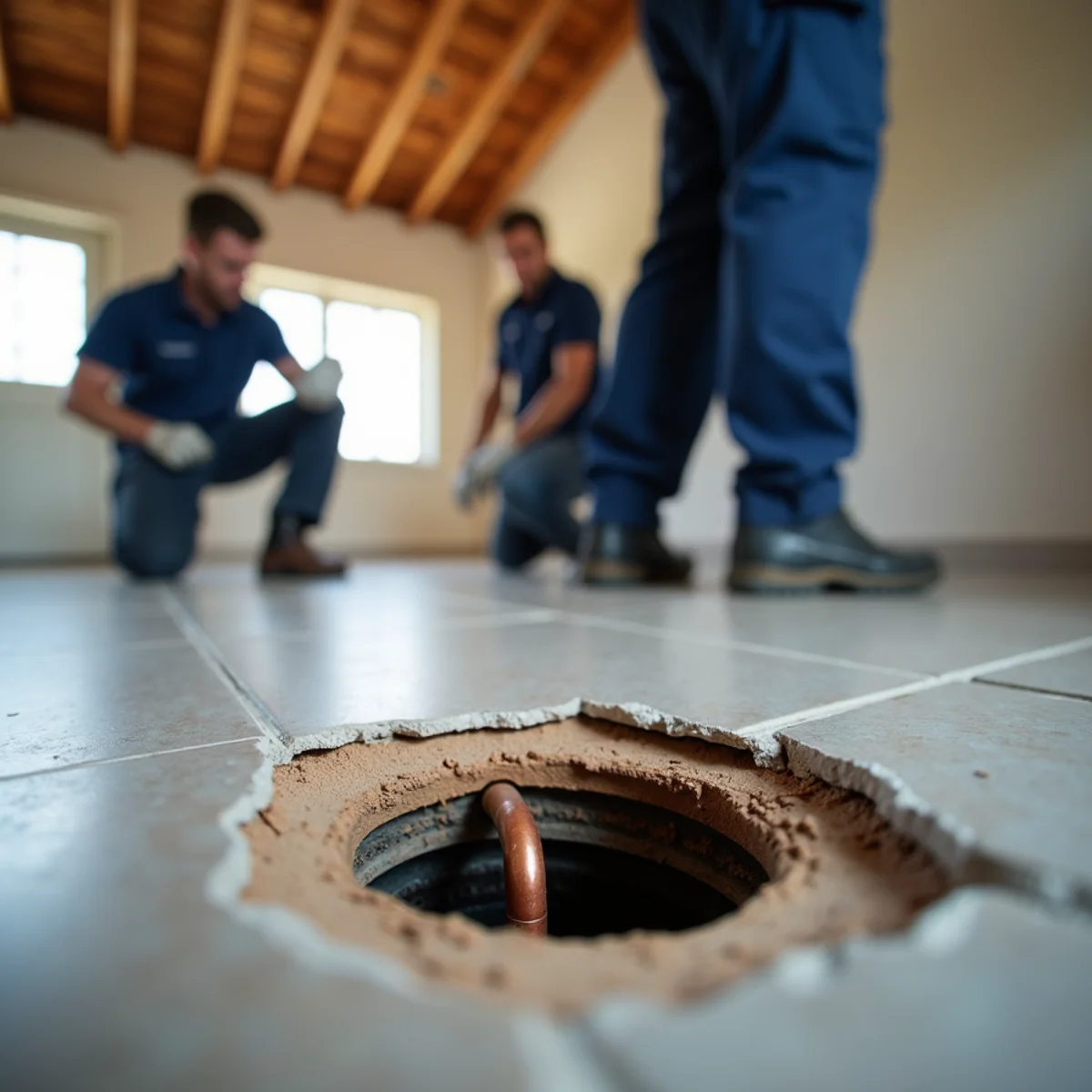
Open the slab at the located point, repair the pipe, patch the concrete, restore the flooring.
Best for: a first failure in otherwise sound pipe, where detection has located the break precisely.
Advantages: lowest cost, shortest disruption, no work in walls or ceilings.
Limitations: it addresses one point in a system. If the pipe material has reached end of life across the house, this is a repair with a queue behind it.
The quality of the leak detection directly determines the cost here. A leak located to within a few inches means opening a small area; a leak located to "somewhere under the east side" means opening far more floor.
Option 2: Reroute
Abandon the failed under-slab section and run a new line overhead through the attic or through the walls, bypassing the slab entirely for that run.
Best for: a second failure on the same line, or a first failure where opening the slab would be particularly destructive — under tile in a mortar bed, or under a kitchen island.
Advantages: no further slab work at that location, ever. The new line is accessible if it ever needs attention.
Limitations: walls and ceilings have to be opened for the new run and then repaired. In a single-story home with attic access this is straightforward; in a two-story it is more involved.
Option 3: Whole-House Repipe
Replace the supply system throughout, typically with PEX or copper, generally routed overhead rather than back under the slab.
Best for: a third failure, or a system where the pipe material has clearly reached end of life — heavily corroded galvanized, or copper producing repeated pinholes.
Advantages: the only option that ends the problem. New material, full service life, and it happens on your schedule with the house dry and the flooring protected.
Limitations: highest cost, most disruption, multiple wall and ceiling openings, and a rebuild phase afterward.
The economics are more favorable than they look. Three emergency spot repairs, each with extraction, several days of drying, flooring replacement and a deductible, frequently total more than a planned repipe — and the repipe does not involve three separate weeks of living around drying equipment.
The Decision Rule
A simple framework that holds up in practice.
- First failure, sound pipe elsewhere, staying a few years → spot repair.
- Second failure on the same line → reroute that line.
- Third failure, or visible systemic corrosion at the repair point → repipe.
- Galvanized supply of any age with falling pressure → repipe is usually the honest answer, whatever the current failure count.
- Selling within a year → disclose, and price the repair option against what a buyer's inspection will surface.
What Insurance Actually Covers
This is where expectations and policy language diverge most sharply.
Generally covered: the resulting water damage — flooring, drywall, baseboard, cabinetry — and, under most California policies, the reasonable cost of *accessing* the pipe. That tear-out provision covers breaking and patching the slab to reach the leak.
Generally not covered: the pipe repair itself. The plumbing work is treated as maintenance of your property.
Almost never covered: a reroute or repipe beyond the failed section. Those are improvements to the system, and carriers treat them as such — even when they are the sensible engineering decision.
So the common outcome is that insurance pays for the damage and the access, and you pay for the plumbing. Knowing that in advance changes how you weigh the three options, because the incremental cost of a reroute over a spot repair is usually entirely yours.
Why This Is So Common in Whittier
The city built out through the 1950s, 60s and 70s as slab-on-grade tract housing, using galvanized steel in the earlier phase and copper in the later one. Both are now at or past the age where failure is routine.
Galvanized corrodes internally and splits at threaded joints. Copper develops pitting corrosion — pinholes — accelerated by the mineral content of Los Angeles County water. Neighborhoods like East Whittier, Sorensen Park and South Whittier are squarely in that window, and the failures cluster street by street because the houses were built together.
A practical signal worth acting on: if several neighbors have repiped in the last few years, your house is on the same clock. More on that in why Whittier's slab-on-grade tracts are slab-leak hotspots.
The Half of the Cost the Plumbing Quote Does Not Include
Homeowners compare plumbing quotes carefully and then get surprised by the total, because the plumbing is only one of three costs on a slab leak. The other two are access and restoration, and on a spot repair they frequently exceed the plumbing itself.
Access means opening the floor covering, breaking and removing a section of slab, and disposing of the spoil. On tile set in a mortar bed, or on solid hardwood, or where the flooring has been discontinued and cannot be matched, that stage alone can dominate the job. Restoration means drying the wet materials the leak already damaged — a slab leak has usually been running for weeks before anyone finds it — and then patching the concrete, replacing the flooring, and repairing whatever baseboard and drywall came out.
Which is why the reroute-versus-repipe decision is often better economics than it first appears. If walls and ceilings are going to be opened anyway for a reroute, the incremental cost of running the remaining lines at the same time is much lower than doing it as a separate project two years later with a second round of access and a second rebuild. The question worth asking any plumber quoting a reroute is simply: what would it cost to do the whole system while you are already in there?
The bottom line
Spot repair for a first failure, reroute for a second, repipe for a third — and repipe sooner if the pipe is galvanized and the pressure has been falling.
Just go in knowing the coverage split: they pay for the damage and the access, you pay for the pipe.