Problem Solving
How Long Does Structural Drying Take? A Room-by-Room Timeline
Most rooms take three to five days. What takes longer, why, and the two things homeowners do that add days.
Water spreading right now? Call before you finish reading — crews are dispatched during the conversation, 24/7.
+1 (201) 277-9344The short answer
Roughly three to four days for carpet over slab, four to six for a bathroom, five to seven for a kitchen, seven to twelve for solid hardwood with mat drying, and two weeks or more before a saturated slab will accept new flooring. Materials set the clock far more than the volume of water does.
Drying is finished when moisture readings match the dry standard for those materials — not on a fixed schedule and not when the surface feels dry.
That said, patterns are consistent enough to give you a realistic expectation by room.
Typical Timelines by Room
These assume a prompt response, proper extraction and a contained drying chamber.
- Bedroom or living room, carpet over slab — three to four days. Straightforward materials, good airflow.
- Bedroom over a crawl space or second floor — four to five days. The subfloor assembly holds moisture longer.
- Bathroom — four to six days. Tile assemblies, mud-set beds and enclosed vanity cavities all dry slowly.
- Kitchen — five to seven days. Cabinet bases, toe-kick voids and enclosed spaces need cavity drying with drilled access.
- Room with solid hardwood — seven to twelve days with mat drying systems. Slower by design, because rapid drying cups and cracks the boards.
- Plaster walls (pre-war homes) — seven days or more. Plaster holds far more water than drywall and cracks under aggressive airflow.
- Saturated concrete slab — often two weeks or more before it will accept new flooring. Concrete releases moisture very slowly.
What Sets the Clock
Four variables, in rough order of influence.
Material. Carpet and drywall dry quickly. Solid hardwood, plaster, tile assemblies and concrete do not. This is physics, not effort.
How much water got in, and how long it sat. Water that has been absorbed deep into a material takes longer to draw out than water that was extracted before it penetrated.
Chamber quality. A sealed, contained, conditioned space with the HVAC managed dries faster than an open house with a window cracked. Containment is genuinely worth its cost in equipment days saved.
Equipment sizing. Air movers create evaporation; dehumidifiers remove what has evaporated. Undersize either and the process stalls.
The Two Things That Add Days
Switching the equipment off overnight. It is loud and the instinct is understandable. It is also the single most common reason a three-day dry becomes six — materials reabsorb moisture from the air the moment airflow stops, and you lose most of a day's progress each night.
Opening the windows. In Whittier, the days you have a water loss are usually the wet days, and outdoor air during a winter storm is more humid than the conditioned air inside the drying chamber. Opening up raises the moisture load the dehumidifiers are fighting.
Keep it sealed, keep it running. Both are free and both shorten the job.
How You Know It Is Actually Done
The dry standard is established by taking readings from unaffected areas of the same house — the same materials, unaffected by the loss. That is what "dry" means for your specific building.
Drying is complete when the affected materials read at or below that benchmark at the same marked locations, and you should receive those final readings in writing.
"Feels dry" is not a standard. Surfaces reliably feel dry several days before framing and subfloor actually are, and closing up over that gap is how mold gets into a wall cavity where nobody will find it. Full detail in our structural drying and dehumidification process.
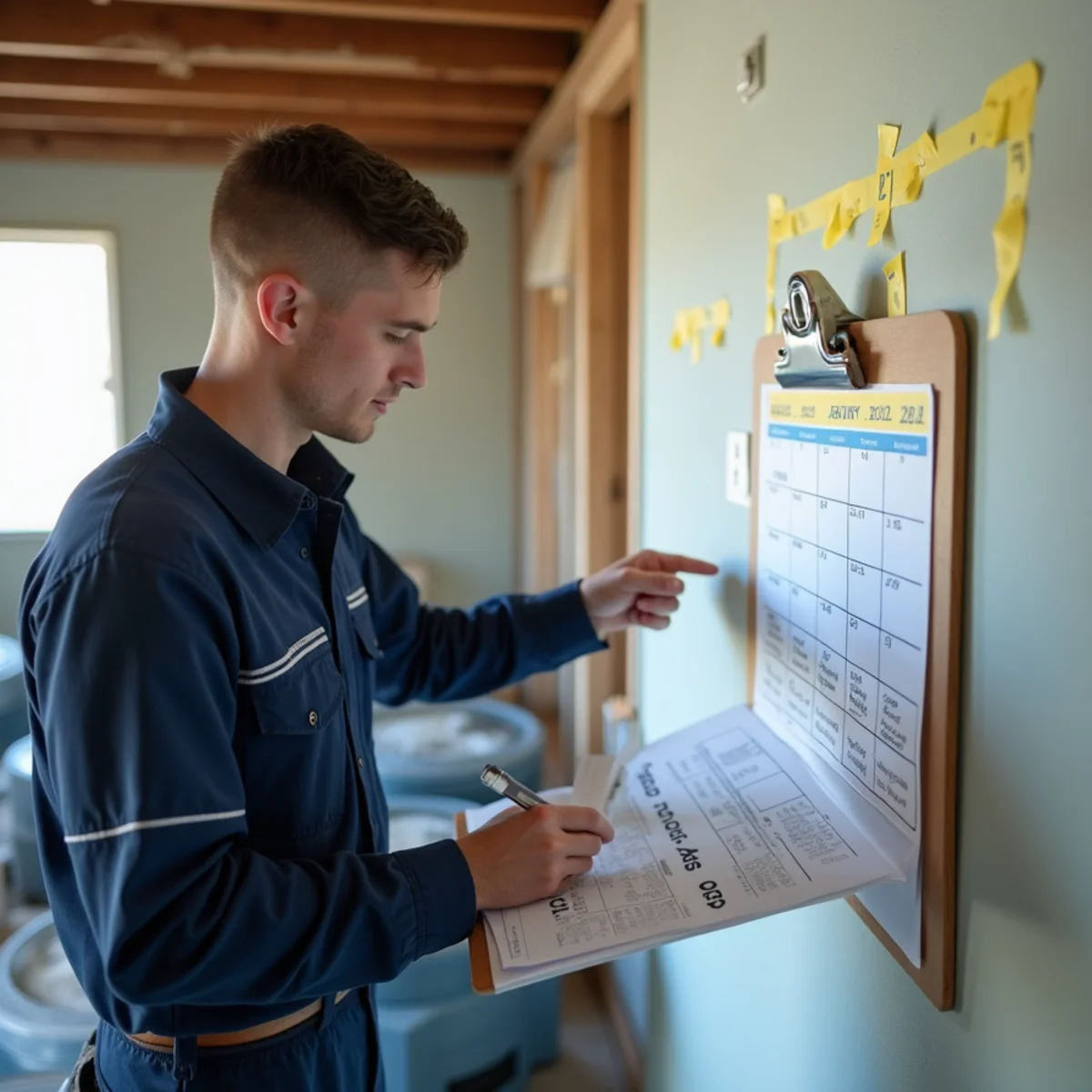
Reading the Daily Log — What a Stalled Dry Actually Looks Like
A drying job that is going well produces a recognisable curve. The first day drops sharply, the second and third drop steadily, the fourth flattens as the material approaches the dry standard. When the readings stop moving before they reach that standard, something specific is wrong, and it is nearly always one of four things.
Either the dehumidifier is undersized for the chamber, so the air is saturating faster than it can be dried and evaporation stalls. Or the chamber is leaking — a door left open, a return vent pulling conditioned air out of the space, a window someone opened during a rainy week. Or there is trapped water somewhere the airflow does not reach: a cavity that was never opened, a toe kick void, a subfloor under floating flooring. Or the material is simply one that plateaus, which hardwood and concrete both do legitimately and should not be forced past.
The practical point for a homeowner is that a plateau is a question to ask, not a thing to wait out. If day four reads the same as day three, ask what changed in the plan — more equipment, a new access point, a repositioned dehumidifier. Waiting quietly for a stalled chamber to resolve itself is how a five-day job becomes a nine-day job with a mold conversation at the end of it.
The bottom line
Three to five days for most rooms, more for hardwood, plaster and slab. Leave the equipment running and the windows shut, and it will be at the fast end of the range.
And ask for the final readings in writing — that document is what ends the job properly.