Commercial & Property Managers
Property Manager's Guide to Tenant Water Damage: Who's Responsible for What in California
The split follows the source and the lease. Everything else is a documentation problem — which is good news, because documentation is controllable.
Water spreading right now? Call before you finish reading — crews are dispatched during the conversation, 24/7.
+1 (201) 277-9344The short answer
Owners are generally responsible for the structure and building systems — plumbing, roof, foundation, water heater — and tenants for their own belongings, damage caused by their negligence, and prompt reporting. The source of the water decides which side starts, and the reporting delay inherent to rentals is what makes these losses larger than owner-occupied ones.
When water damages a rental, the technical question is straightforward and the responsibility question is not. This is an orientation to how the split generally works in California, not legal advice — your lease and counsel govern.
The practical point underneath all of it: the source of the water decides most of it, and the source is a matter of evidence.
The General Split
Owner responsibility typically covers the structure and the building systems: plumbing, roof, foundation, and the fixtures that came with the unit. It also carries the habitability obligation — California law requires rental units to be maintained in a habitable condition, and significant water damage or mold affecting a unit engages that obligation.
Tenant responsibility typically covers their own belongings, damage caused by their negligence, and the duty to report problems promptly. A tenant's personal property is covered by their renters policy, not by the owner's.
The source determines which side starts. A failed supply line in the wall is a building systems failure. An overflowing bath left running is tenant negligence. A tenant who reported a leak three months ago that was never addressed shifts the picture considerably.
The Reporting Delay Problem
This is the structural issue in rental property and it is worth managing deliberately.
Owner-occupied homes report leaks within hours. Rentals frequently do not — a tenant lives with a damp patch, assumes someone else knows, or reports it to a manager who queues it. By the time anyone acts, a drying job has become a demolition and mold job.
Two things reduce it. Make reporting frictionless — a single number or form, no judgment, and an explicit statement in the lease that plumbing issues should be reported immediately. And inspect proactively, particularly under sinks, around water heaters and behind washing machines during any routine visit.
The cost curve here is steep enough that a fifteen-minute inspection at every turnover is straightforwardly worth it.
Habitability and Relocation
When water damage or resulting mold affects a unit's habitability, the owner's obligations engage and the practical questions become urgent.
Can the tenant remain in part of the unit while work proceeds? Is the only bathroom or kitchen affected? Is there a household member with a respiratory condition? Contaminated water in living space generally means relocation.
Handle this proactively rather than reactively. Document the conditions, communicate the timeline in writing, and address relocation before it becomes a dispute. The documentation supporting a relocation decision is also what supports any claim relating to it.
The Documentation That Settles It
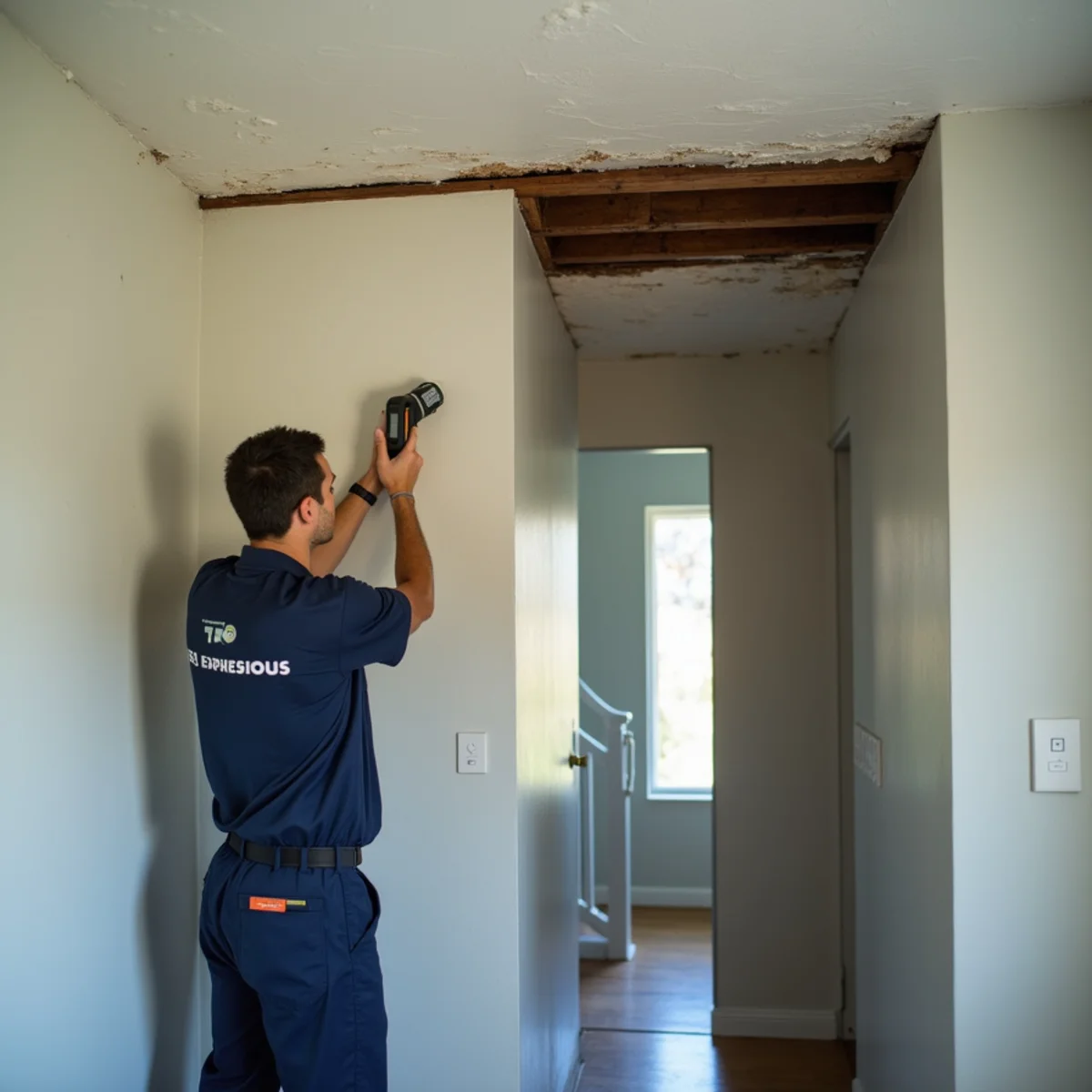
Almost every landlord-tenant water dispute is a factual disagreement about source, timing or extent. All three are recordable.
- Source, established and photographed — the failed component, in place, before removal
- Discovery and report dates, from the tenant's report through to the response
- Extent, from moisture mapping rather than visual assessment
- Condition at move-in, from the original inspection record — which is why those need to be thorough
- All communications in writing, including notice of entry and work schedules
- Daily moisture readings through the drying phase
- A contents inventory, separating tenant property from owner fixtures
Portfolio Prevention
Across a portfolio, a small number of components cause most losses, and they are all cheap.
Washing machine hoses, flexible supply connectors under sinks and toilets, angle stops, and water heaters past twelve years. Replacing those on a schedule at turnover costs very little per unit and removes the majority of the failure modes.
Add leak sensors under water heaters and behind washing machines in units that are hard to inspect, and consider a flow-monitoring shut-off system for any property that sits vacant between tenancies.
We work with owners and managers across Norwalk, Paramount and the surrounding rental markets, and the pattern is consistent: the expensive losses are almost always cheap components that were never on a replacement schedule.
Turnover Is the Only Reliable Inspection You Get
Across a rental portfolio the single most useful lever is not maintenance frequency or sensor coverage. It is the turnover inspection, because it is the one moment you have unrestricted access, an empty unit, and a legitimate reason to look behind things.
A thorough fifteen minutes at turnover catches almost everything that later becomes a claim: the toe kick under a sink base that has gone soft, the supply connectors nobody has dated, a water heater past its tenth year, an angle stop that no longer turns, a wax ring beginning to fail, and staining under an upstairs bathroom that the outgoing tenant never mentioned. Photograph all of it. That record is also the condition baseline that resolves the deposit and negligence arguments that otherwise turn into disputes with no evidence on either side.
The second lever is making reporting frictionless, and it is worth being explicit with tenants that reporting a leak will not be held against them — the delay in rentals is usually social rather than practical, someone reluctant to make a fuss over a damp patch. A single number or form, an acknowledged response time, and no judgment attached. A leak reported on day one is a drying job; the same leak reported at the end of the month is flooring, cabinetry and a mold conversation, and the difference is a phone call that felt awkward to make.
The bottom line
Source, timing, extent. Record all three properly and the responsibility split follows from evidence rather than argument.
And put the cheap components on a replacement schedule — that is where the portfolio losses actually come from.