Problem Solving
Why Shop-Vaccing a Flooded Carpet Isn't Enough (What Professional Extraction Pulls Out)
The carpet feels dry within a day. The padding beneath it does not, and that is where the mold problem starts.
Water spreading right now? Call before you finish reading — crews are dispatched during the conversation, 24/7.
+1 (201) 277-9344The short answer
A shop vac pulls water from the carpet fiber and a little from the top of the pad. Most of the water is in the padding, which is manufactured to absorb and hold. Weighted extraction compresses carpet and pad together and recovers several times more, which is why the fiber feels dry while the pad underneath is still saturated.
A shop vac is a genuinely useful tool and there is nothing wrong with reaching for one. The problem is what it cannot reach.
Carpet is a wick. The pad underneath is a sponge. And the two behave completely differently when they get wet.
Where the Water Actually Is
Carpet fiber holds relatively little water. Most of it passes straight through into the padding, which is manufactured specifically to be absorbent and compressible — a closed-cell or bonded urethane pad can hold several gallons per square yard.
A shop vac draws water from the surface it is sitting on. It pulls what is in the carpet fiber and a little from the very top of the pad, and then it stops recovering because it has no way to compress the pad and force water upward.
Which is why the carpet feels dry to the touch by the next morning while the pad beneath it is still saturated, and stays that way for weeks.
What Professional Extraction Does Differently
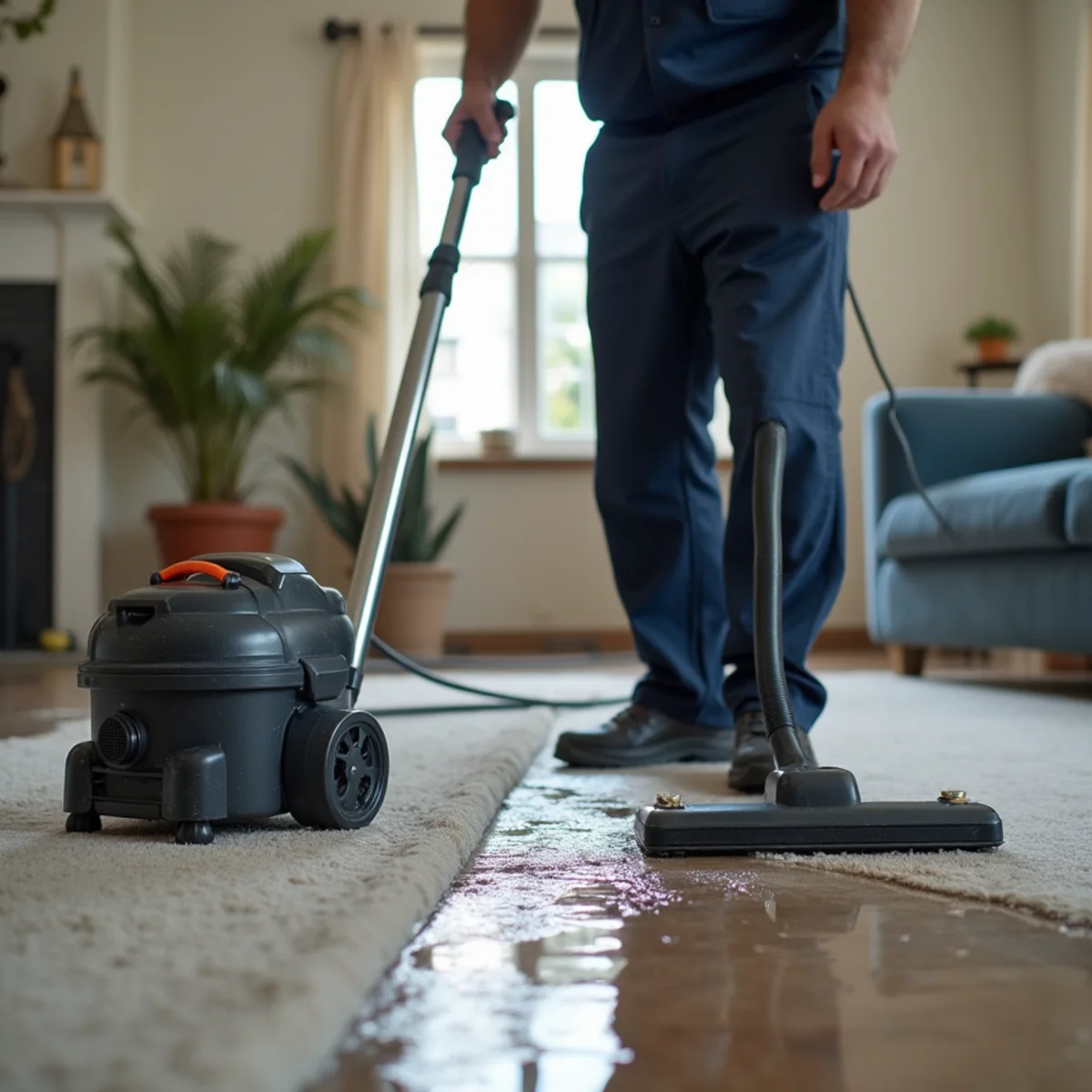
Weighted extraction tools apply the operator's body weight through the head, compressing the carpet and pad while vacuum is applied. That squeezes water up out of the pad rather than skimming it off the top.
It is done in slow overlapping passes, and the operator watches the recovery tank. When the tank stops filling on a pass, that section is done — mechanically, everything removable has been removed.
The difference in recovered volume between a shop vac and weighted extraction on the same wet carpet is not marginal. It is the difference between a three-day dry and a torn-out floor.
Why Mechanical Removal Beats Evaporation
Every gallon extracted mechanically is a gallon that does not have to be evaporated into the air and then pulled back out of the air by a dehumidifier.
Evaporation is slow and expensive. Extraction is fast and cheap. That is the entire logic of restoration sequencing: do as much as possible mechanically, then dry what is left.
Setting fans over water that has not been properly extracted is the most common homeowner mistake. It puts moisture into the air, raises humidity throughout the house, and lets it reabsorb into materials that were dry.
When the Pad Comes Out Anyway
Sometimes extraction is not the answer and removal is. The honest conversation happens on day one.
For clean supply water caught quickly, we extract, float the carpet and dry the pad in place with directed airflow underneath. For water that has sat, or anything above Category 1, the padding comes out — it is inexpensive to replace and it holds moisture and contamination longer than anything else in the room.
Carpet itself is frequently salvageable even when the pad is not. It is worth asking any company that wants to remove both to explain why.
The Tack Strip Problem
Water at the edge of a room does not stop at the wall. It runs under the tack strip and into the gap at the base of the drywall, then wicks upward into the wall cavity.
That is invisible from the room and it is why we take moisture readings at the wall base rather than in the middle of the floor. In slab homes across East Whittier and Whittwood, that wall-base reading is often the one that reveals the real extent of the loss.
How We Decide Whether the Padding Stays or Goes
This decision gets made on day one, before any equipment is set, and it is worth understanding because it is the single biggest cost variable on a carpeted loss.
Three things drive it. First, the water category — clean supply water gives the pad a chance, gray water usually does not, and category 3 removes the question entirely. Second, elapsed time, because a pad that has been saturated for more than about a day has been a warm damp organic environment for long enough that drying it in place stops being a sound bet. Third, what the pad is made of: bonded urethane chip foam, which is what most of these tracts have, holds water very differently to a thin rebond or a rubber slab, and the denser it is the longer it takes.
Where the pad stays, the technique is to extract heavily, then float the carpet — lift it off the tack strip along one or two edges and blow warm dry air underneath it, so the pad is being dried from both faces rather than through the carpet. Where the pad goes, the carpet itself is very often still salvageable: it is a manufactured fiber on top of the assembly, and pulling it, replacing the pad and re-stretching it costs a fraction of a full replacement. Any company that wants to bin the carpet and the pad together on a clean-water loss should be asked to justify it against the readings.
The bottom line
Use the shop vac for the surface if it helps. Just do not conclude from a dry-feeling carpet that the job is done.
The pad decides that, and only extraction and a meter can tell you.