Prevention & Maintenance
Gutters, Downspouts, and Yard Drainage: A Pre-Rainy-Season Checklist for Whittier Homes
A roof sheds water perfectly and then hands the whole problem to your gutters, downspouts and yard. That handoff is where most local water damage starts.
Water spreading right now? Call before you finish reading — crews are dispatched during the conversation, 24/7.
+1 (201) 277-9344The short answer
Clear gutters of silt as well as leaves, check they still fall toward the downspouts, and confirm every downspout discharges four to six feet clear of the foundation. Lift each drain grate and clear the basin beneath, hose-test that it flows, verify the grade falls away from the house, and check crawl space vents sit above grade.
People inspect roofs and ignore drainage, and the numbers run the other way. More of the storm losses we attend in this area come from water arriving at ground level than from water coming through a roof.
Drainage is also the cheapest thing on any maintenance list, which makes the neglect harder to justify.
The Handoff Problem
Think about the volume involved. A modest roof sheds a very large quantity of water during a heavy storm, and it delivers all of it to a handful of downspouts.
If those downspouts discharge next to the wall, you have concentrated a roof's worth of rainfall into a few square feet of soil directly against your foundation — repeatedly, for days.
That soil saturates, and saturated soil against a foundation finds any path available: a crack, a crawl space vent, a slab joint, a low threshold. This is the mechanism behind most of the ground-level entry we attend.
Gutters and Downspouts
Clear the gutters completely — not just the leaves on top, but the compacted silt underneath that actually blocks flow. Then run a hose to confirm each downspout is clear through its full length.
Check the fall. Gutters should slope toward the downspouts, and sections that have sagged over the years pond water and overflow at the low point rather than draining.
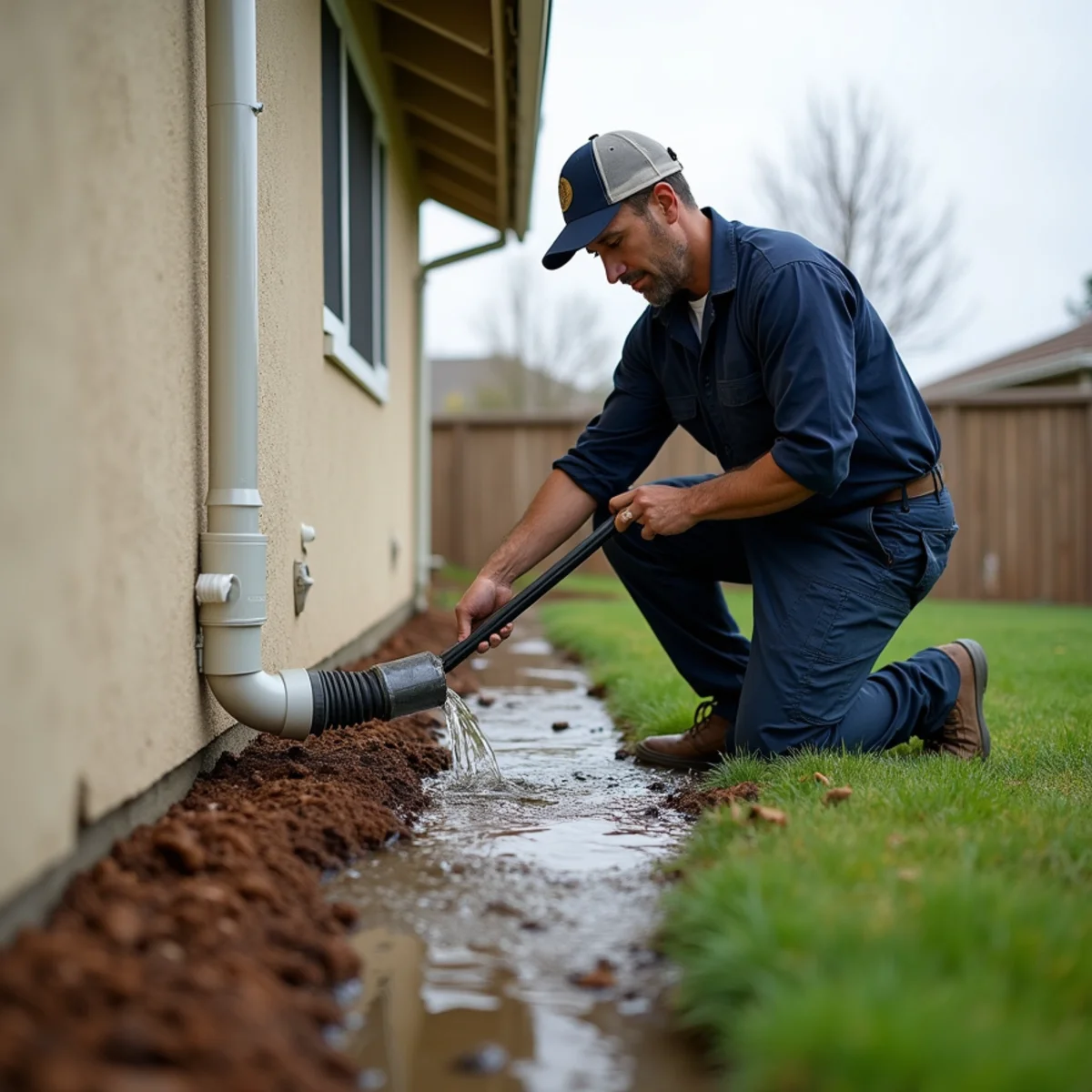
Then the important part: where does the water go when it leaves the downspout? It should be discharged at least four to six feet from the foundation, further on a slope. Downspout extensions cost very little and are among the highest-value items in this entire article.
Where a downspout ties into a buried drain line, confirm that line is actually flowing — buried lines silt up and crush, and a blocked one backs water up at the base of the downspout where you cannot see it.
Area Drains and Yard Drainage
Lift every drain grate on the property and clear the basin beneath it. Leaves on the grate are obvious; the silt in the basin is what actually blocks the system.
Then run a hose into each one and confirm it flows away. If water backs up, the buried line is blocked and needs clearing — the same equipment used on sewer lines works here.
Walk the property during the first real rain of the season and watch where water actually goes. That fifteen minutes tells you more than any inspection in dry weather, because it shows you the pooling points, the flow paths and the places water reaches that it should not.
Grade — The One People Get Wrong
Soil around a house should fall away from the structure. Original construction almost always got this right.
What changes it is thirty years of added landscaping, new planting beds, mulch topped up annually, raised borders, and hardscape poured over previous grade. Each addition raises the soil a little, and eventually the ground slopes toward the house instead of away from it.
It is worth checking with a level and a straight edge rather than by eye. Where the grade has reversed, the correction is regrading — moving soil rather than building more drainage — and it is usually straightforward.
Also check that crawl space vents sit above the surrounding grade. Decades of added soil frequently buries them level with or below the ground, which turns a ventilation opening into a water inlet.
Hillside and Slope Properties
Properties on slopes — Rose Hills, the Friendly Hills foothills, Hacienda Heights, Rowland Heights — depend on engineered drainage that needs its own attention.
Terrace drains cut into the slope, swales, and hillside subdrain outlets all silt up over the dry season and are invisible until the storm they exist for arrives. Clear them and confirm the outlets are flowing.
Check retaining wall weep holes are open. A wall whose drainage has blocked holds saturated soil at far higher pressure than it was designed for, and it will seep through the wall face into whatever is behind it — commonly a garage or a lower level.
The Handoffs Are Where Systems Fail
A drainage system is really a chain of handoffs — roof to gutter, gutter to downspout, downspout to grade or buried line, grade to area drain, area drain to the street. Each link usually works. Failures cluster at the joints between them, which is why an inspection that checks components individually can pass a system that will not perform.
The handoff that fails most often is downspout to ground. The gutter is clean, the downspout is clear, and the water lands on soil eighteen inches from the wall — so a roof plane worth of storm runoff is concentrated into a small area of ground against the foundation, several times an hour, for days. That is the mechanism behind most crawl space water and a good share of the damp we find at wall bases in older single-story homes. It is also the cheapest thing on the entire list to fix, with an extension or a splash block.
The second is downspout to buried line. Where a downspout ties into a below-grade drain, the visible parts can be spotless while the buried run is silted solid, and there is no way to know without testing it. Run a hose into the top and watch the outlet. If nothing arrives, the water backing up during a storm has to go somewhere, and it goes into the ground right at the foundation — the one place the whole system exists to keep it away from.
The bottom line
Clear the gutters, extend the downspouts, clear the area drains, and check the grade has not reversed.
Then walk the property during the first rain and watch where the water actually goes. That is the real inspection.