Local Whittier Angles
LA County Hard Water Is Eating Your Copper Pipes: What Whittier Homeowners Can Do About Pinhole Leaks
A hole smaller than a pencil tip in a pipe that looks perfectly healthy. Here is what causes it and which of the popular fixes actually help.
Water spreading right now? Call before you finish reading — crews are dispatched during the conversation, 24/7.
+1 (201) 277-9344The short answer
Pitting corrosion breaches the protective oxide layer inside copper pipe and concentrates at a single point until it opens a pinhole. Local water chemistry, turbulence in undersized runs and higher hot-line temperatures all accelerate it. Softeners and filtration do not stop the mechanism — repiping, commonly with PEX, is what ends it.
Homeowners across this area describe the same thing: a plumber cuts out a section of copper, and the pipe looks fine. Solid, clean, no obvious corrosion. And there is a tiny hole in it.
That is pitting corrosion, and it works from the inside out. Which is why nothing shows until the pipe fails.
What Pitting Corrosion Actually Is
Copper is normally protected by a thin oxide layer that forms on the inside of the pipe and stops further corrosion. Pitting happens where that protective layer breaks down at a localized point.
Once it does, an electrochemical cell establishes at that spot. Corrosion concentrates there rather than spreading evenly, eating a narrow pit downward through the pipe wall. The surrounding metal stays healthy — which is exactly why the failed section looks fine.
The result is a hole often smaller than a pencil tip, weeping continuously at line pressure. In an accessible wall it drips visibly. Under a slab it does not, and the first sign is a warm floor or a water bill.
Why Local Water Is a Factor
Los Angeles County water is hard — it carries significant dissolved mineral content, principally calcium and magnesium. Water in this region comes from a mix of imported supply and local groundwater, and hardness varies by supplier and blend across the service area.
Hardness on its own does not cause pitting. What matters is the overall water chemistry — mineral content, pH, disinfection residual, dissolved oxygen and temperature — interacting with the pipe over decades. Hardness is a recognized contributing factor rather than a single cause.
Two other local factors compound it. Velocity: undersized runs and tight fittings create turbulence that wears the protective layer. Temperature: hot lines pit faster than cold, which is why hot-water slab leaks are over-represented in the calls we take.
The Rule That Matters: They Do Not Come Alone
This is the practical takeaway. The conditions that produced one pinhole exist throughout the same pipe, installed at the same time, carrying the same water.
One failure is an event. A second within a couple of years is a pattern. A third means the material has reached the end of its useful life, and continuing to spot-repair is paying for a repipe in instalments — with an emergency and a deductible attached to each installment.
In neighborhoods like Sorensen Park and California High Area, where the housing is in or entering that window, this is the single most useful thing to understand.
What Helps, and What Does Not
Being honest about this saves people money on products that will not solve it.
A water softener reduces scale and has genuine benefits for appliances, water heaters and fixtures. Its effect on pitting corrosion specifically is more complicated — softened water changes the chemistry in ways that are not uniformly protective. Buy one for scale and appliance life, not as pinhole insurance.
Whole-house filtration helps with sediment and taste. It does not address the electrochemical process inside the pipe wall.
Epoxy pipe lining is a real option for some systems, coating the interior of existing pipe. It has genuine applications and genuine limitations, and it needs assessment by someone who does not sell only that solution.
Repiping is the option that actually ends it. PEX has become the common choice — it does not pit, it tolerates the local water chemistry, and it is generally run overhead rather than back under the slab, so future access is straightforward.
Catching Them Early
Since you cannot see pitting from outside the pipe, detection is about symptoms and testing.
Run the meter test seasonally — every fixture off, watch the meter. Walk tile floors barefoot and note any warm patch. Watch for a water bill that steps up and stays. And treat gradually reducing pressure as information rather than an annoyance.
If any of those show up, professional leak detection locates the point without opening anything — which is what keeps the repair to inches of concrete rather than feet.
Keep the Failed Section — It Tells You What to Do Next
When a plumber cuts out a failed length of copper, ask for it. It is small, it costs nothing to keep, and it answers the question that decides your next several thousand dollars: is this one bad spot, or is the whole system going?
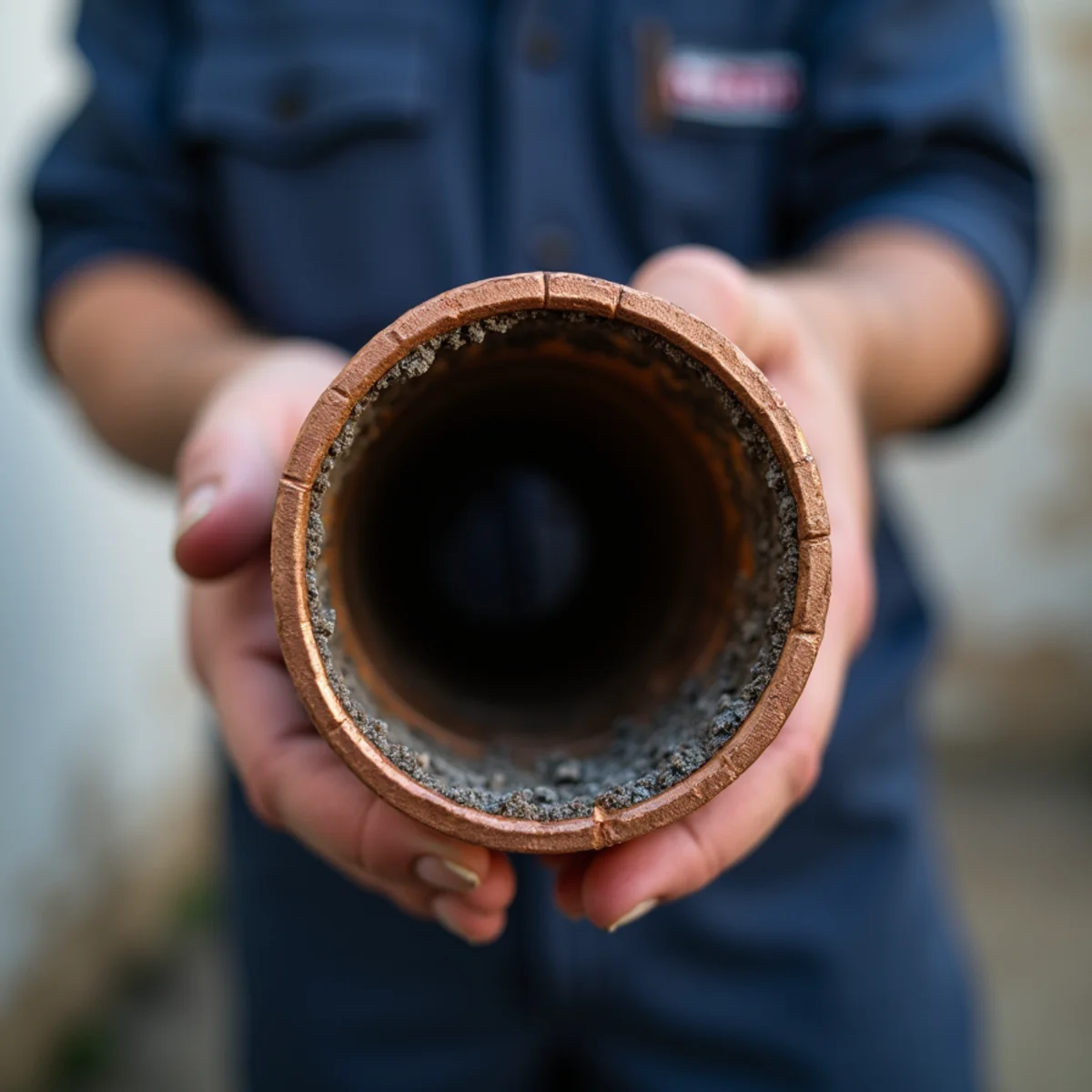
The distinction shows on the inside of the pipe. Pitting corrosion produces a discrete crater — a small, deep, localized hole with sound metal around it — often with a green or blue-green mound over it and a bore that otherwise looks reasonable. That pattern is chemistry acting on the material generally, which means the same conditions exist along every foot of the same installation. Erosion corrosion looks different: horseshoe-shaped grooves undercut in the direction of flow, usually just downstream of a tight fitting or in a run that is undersized for its demand. That is a hydraulics problem at a specific location, and correcting the run can genuinely resolve it.
A third pattern is worth knowing because it changes the conversation entirely: heavy internal scale narrowing the bore across the whole section. That is the local hardness doing its slow work, and it explains falling pressure across the house better than any single leak does. It also increases velocity through the remaining opening, which feeds back into the erosion mechanism. A pipe like that is not a repair candidate — it is a system at the end of its life, and the honest advice is to plan the replacement rather than chase the next pinhole.
The bottom line
A pinhole is a symptom of a system, not an accident in one pipe.
Treat the first one as information, the second as a decision point, and the third as confirmation you should have decided already.