Problem Solving
Sewage Backing Up Into the Shower: Causes, Health Risks, and Safe Cleanup
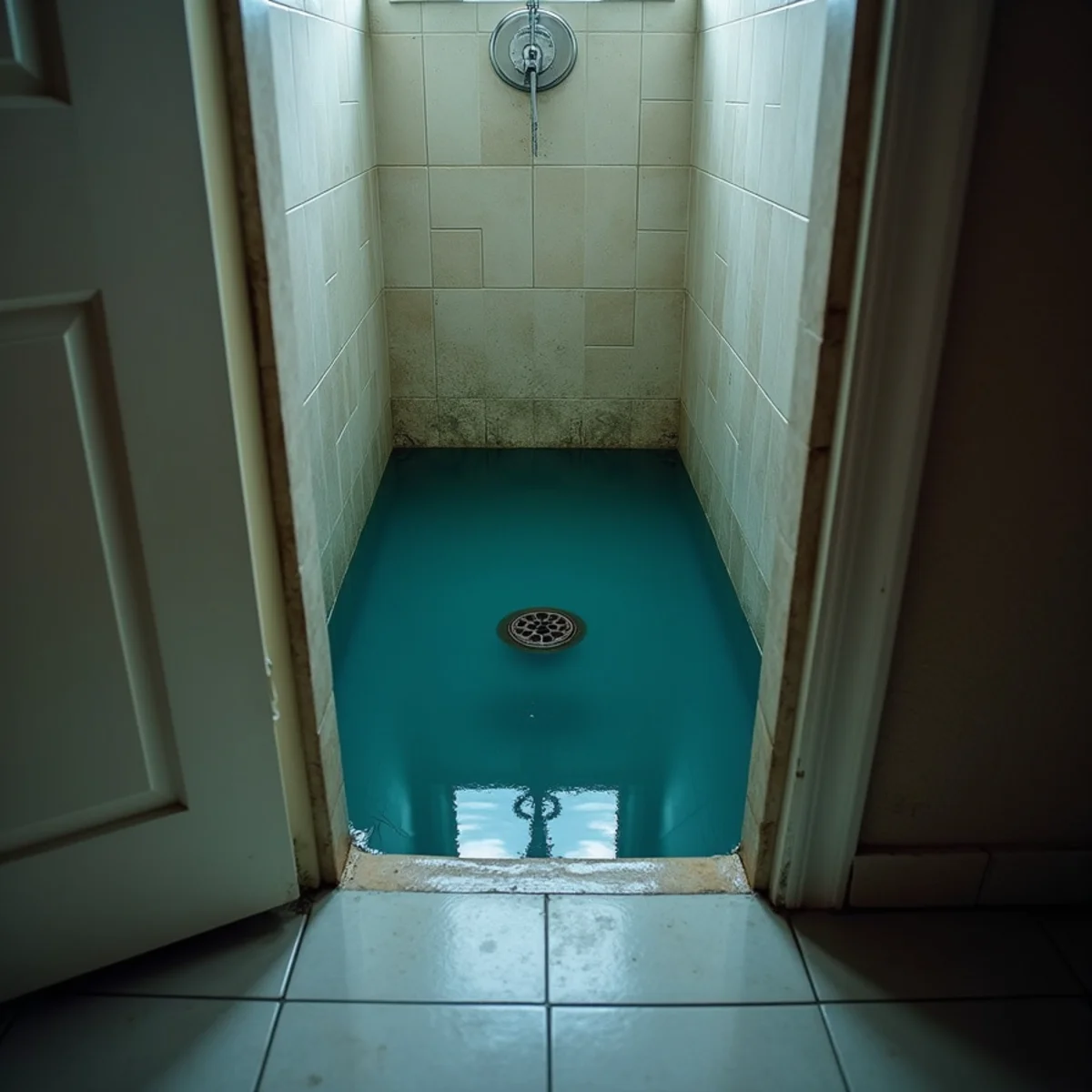
It comes up in the shower because the shower is the lowest opening in the system. That tells you exactly where the problem is.
Water spreading right now? Call before you finish reading — crews are dispatched during the conversation, 24/7.
+1 (201) 277-9344The short answer
It backs up at the shower because plumbing drains by gravity and the shower pan is the lowest opening in the house — so a blocked main line pushes waste up there first. The usual causes are root intrusion in a clay lateral, grease and solids build-up, or a collapsed section. Treat it as category 3 and stop using water.
Stop running water anywhere in the house. That is the first thing, before anything else — every drain in the building feeds the same blocked line, and every liter you send down it comes back up at the lowest opening.
Which is why it is your shower or your tub rather than a sink.
Why the Shower and Not a Sink
Plumbing drains by gravity. When the main line downstream is blocked, waste water backs up and rises through the system until it finds an opening — and it exits at the lowest one available.
In a single-story home that is nearly always a shower pan, a bathtub, or a floor drain, because those sit at floor level while sinks sit at counter height.
That is the diagnostic. Waste appearing at your lowest fixture, especially when you run water somewhere else, means the blockage is in the main line or the sewer lateral, not in that fixture.
What Is Actually Blocking It
Three common causes, in order of how often we see them locally.
Root intrusion in the lateral. The dominant cause in older Whittier-area neighborhoods. Clay-tile laterals in short jointed sections leak a little moisture at each joint; roots from mature street trees grow toward it and form a net inside the pipe. Restriction builds over years.
Grease and solids accumulation. Especially in cast-iron lines that have scaled internally and present a rough surface for material to catch on.
A collapsed or offset section. Clay tile is brittle and ground movement, root pressure or simple age can break or displace a section. Camera inspection distinguishes this from a clog, and the fix is different.
The Health Risk Is Real
Sewage is Category 3 water carrying bacteria, viruses and parasites. This is the one water loss where the health exposure genuinely outweighs the property damage.
Keep people and pets out of the affected rooms. Do not attempt to clean it with a mop and bleach — beyond the direct exposure, household cleaning aerosolizes what you are trying to remove, and disinfectant applied over remaining organic soil accomplishes very little.
Turn the HVAC system off. Air handlers distribute contamination through a whole house with remarkable efficiency, and running one during a backup turns a bathroom problem into a building problem.
What Proper Cleanup Involves
Containment first — the affected area sealed, negative air where appropriate, HVAC isolated. Crews in full PPE from the outset rather than upgrading halfway through.
Then extraction with dedicated equipment, removal of porous materials that absorbed the water, and cleaning before disinfection. That order matters: physical cleaning removes the soil load, and only then does antimicrobial do anything useful.
Then drying with daily readings and verification before anything is closed up. Deodorizing comes last, after the source material is gone — never instead of removing it. Full detail in sewage cleanup and backup removal.
Preventing the Next One
Once the immediate problem is resolved, get the lateral camera-inspected. It answers the only question that matters: is this roots you can manage with periodic cutting, or a failed section that needs replacing or lining.
A backwater valve on the lateral is worth pricing. It allows flow out and prevents flow back into the house, which is exactly the failure mode you have just experienced.
And check whether your policy has a water backup endorsement. Standard California policies exclude sewer backup, and the endorsement is usually inexpensive — see sewage backup cleanup costs and coverage.
What Sets the Scope on a Bathroom Backup
Two bathrooms with visibly identical backups routinely produce very different scopes of work, and the difference is almost always what is under and behind the fixtures rather than what is on the floor.
The controlling factors are the floor assembly and the wall base. Sealed tile over a sound mortar bed with intact grout is semi-porous — it is cleaned, treated and kept. Sheet vinyl over a particle-board underlayment is not: contaminated water finds the seams and the perimeter, the underlayment absorbs it, and both come out. Drywall behind the baseboard wicks upward regardless of what the floor is made of, which is why a flood cut appears on these jobs even when the water was only an inch deep.
The fixture that decides the rest is the toilet. Contaminated water travels under the closet flange and into the subfloor around it, where nothing applied from above will reach. Lifting the toilet, cleaning the flange area and the subfloor beneath, and resetting on a new wax ring is standard on a category 3 bathroom, and a cleanup that skipped it is the most common reason an odor returns two weeks later in a room that was supposedly finished.
The bottom line
Stop using water, keep everyone out, turn off the HVAC, and call.
Then get the lateral on camera — because a backup that happened once from root intrusion will happen again on the same schedule.