Problem Solving
Tree Roots in Your Sewer Line: Warning Signs to Catch Before the Backup
A blocked sewer line never fails suddenly. It restricts over years, and it tells you at every stage — if you know what the signals mean.
Water spreading right now? Call before you finish reading — crews are dispatched during the conversation, 24/7.
+1 (201) 277-9344The short answer
Watch for one fixture draining slowly, then several; gurgling from a tub or floor drain when a toilet flushes; sewer odor at a yard cleanout; and water rising in a tub when you run a sink. That sequence runs over months. Acting at stage one or two is far cheaper than acting at a full backup.
The mature trees that make older Whittier neighborhoods pleasant to walk are the same trees whose roots have been inside the sewer laterals for decades.
The good news is that this failure is unusually well signposted. Almost every backup we attend had three or four clear warnings first.
How Roots Get In
Sewer laterals carry warm, moist, nutrient-rich water. Any joint or hairline crack releases a small amount of vapor into the surrounding soil, and roots grow toward moisture.
Once a fine root reaches a joint it grows through, then thickens inside the pipe where conditions are ideal. Over years it forms a net across the flow, and paper and solids catch on it.
Vitrified clay tile in short jointed sections — standard in construction before roughly 1970 — is by far the most vulnerable, because it has a joint every few feet. Cast iron is more resistant but corrodes and cracks with age.
The Warning Signs, in Order
These appear in a fairly consistent sequence. Catching it at stage one or two is the difference between a maintenance visit and a Category 3 cleanup.
- Stage 1: one fixture draining more slowly than it used to, usually the lowest one
- Stage 2: several fixtures slow, or a toilet that needs a second flush
- Stage 3: gurgling from a tub, shower or floor drain when a toilet flushes or the washing machine drains
- Stage 4: sewer odor at a yard cleanout, or an unusually green or sunken patch of lawn over the line
- Stage 5: water rising in a tub or shower when you run a sink
- Stage 6: full backup into the lowest fixture in the house
The Seasonal Pattern
Root growth happens through the warm dry months, when the soil moisture around a leaking joint is the most attractive thing available.
Then the first heavy November rain loads the system — more flow, more groundwater infiltration through the same compromised joints — and the restricted line finally fails to carry it.
That is why backup calls cluster in the same few weeks each year across Penn Park, Central Whittier and older parts of West Whittier-Los Nietos. If you have had two slow-drain episodes this year, the November system is what will finish it.
Get It on Camera
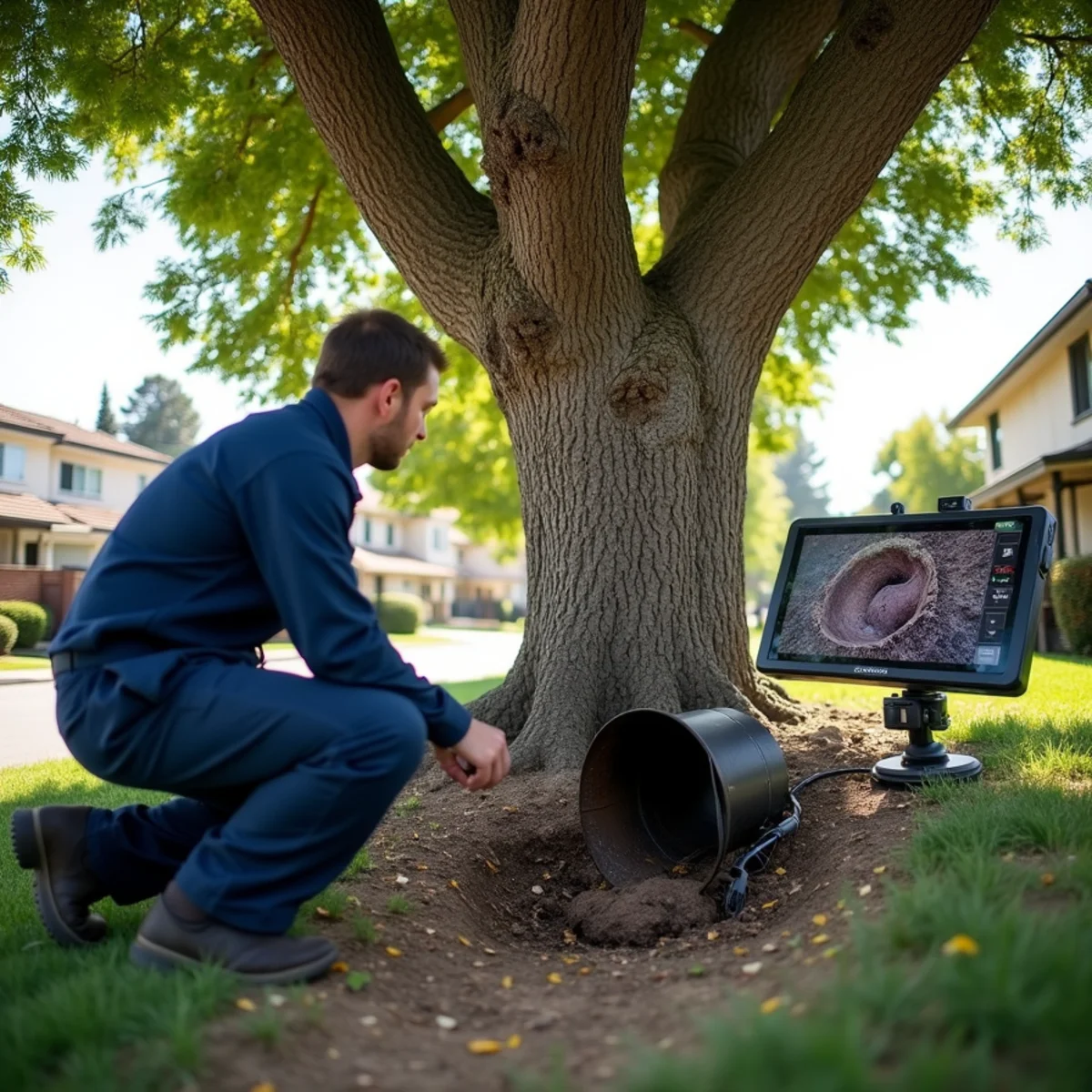
Drain cleaning without inspection is a repeating expense. A camera inspection is the diagnostic that ends the guessing, and it distinguishes three very different situations.
Root intrusion in otherwise sound pipe — manageable with periodic cutting on a schedule, or with lining.
A collapsed or offset section — no amount of cleaning fixes this; the section needs replacing.
Grease or solids accumulation — cleaning works, and a habit change prevents recurrence.
Ask for the footage. A reputable operator will hand it over, and it is worth keeping for the next time somebody quotes you work on that line.
What Not to Do
Do not rely on chemical root killers as a strategy. They may slow regrowth at the treated point; they do not clear an established mass and they do not repair the joint that let the roots in.
Do not remove a mature tree as a first response. It is expensive, often unnecessary, and the roots already in the line stay there. Fix the pipe.
Do not ignore stage one. A single slow drain is the cheapest moment in this entire sequence to act.
Cutting, Lining or Replacing — Choosing From the Footage
Once a camera has been down the line, three repair paths are on the table, and the footage is what should decide between them rather than whoever is holding the phone.
Periodic cutting is maintenance rather than repair. A mechanical cutter clears the intrusion and the roots grow back, so it commits you to a schedule — typically annual, ahead of the rainy season. It is the right answer for a sound clay line with modest intrusion at one or two joints, and it is the cheapest way to keep an old lateral in service.
Lining — a cured-in-place liner pulled through and set inside the existing pipe — seals the joints roots were entering through, so it ends the recurrence rather than managing it. It requires a host pipe with enough integrity to line against, which the camera establishes, and it is trenchless, which matters if the run goes under a driveway or mature planting. Replacement is what a collapsed, offset or badly deteriorated section requires; nothing else fixes a pipe that has lost its shape. The signal to watch for is a contractor recommending repeated cutting on a line the footage shows as offset or crushed — that is a subscription, not a solution.
The bottom line
One slow drain is information. Two is a pattern. Gurgling is a warning.
Get a camera in the line before November, and you will very likely never meet the alternative.