Emergency Guides
Ceiling Leaking During a Storm? What to Do in the Next 30 Minutes
A bulging ceiling is holding more water than it looks and it fails without warning. Clear the room first, then relieve it deliberately.
Water spreading right now? Call before you finish reading — crews are dispatched during the conversation, 24/7.
+1 (201) 277-9344The short answer
Clear the room and switch off the circuit feeding any light or fan near the wet area. If the bulge is modest and the surrounding ceiling is sound, relieve it with one small hole at its lowest point over a bucket. Contain, photograph, and stay off the roof — the entry point is rarely directly above the stain.
Wet drywall is several times its dry weight and it does not sag gracefully before it gives — it holds, then it goes, usually taking the light fixture with it.
So the order here is: get people out, kill the circuit, then relieve the water on your terms rather than the ceiling's.
First: Clear the Room and Kill the Circuit
Move people, pets and anything valuable out from under the affected area, and out of the adjacent space if the staining is spreading.
If there is a light fixture, ceiling fan or recessed can anywhere near the wet area, switch that circuit off at the breaker. Water travels along the top of drywall and finds ceiling penetrations — light fixtures are the most common exit point, which puts water directly into an energized fitting.
Do not stand under it while you assess it.
Second: Relieve the Bulge Deliberately
This feels wrong and it is correct. A bulging ceiling is a bag of water held by a material that is losing strength by the minute. Left alone it will fail somewhere unpredictable, all at once.
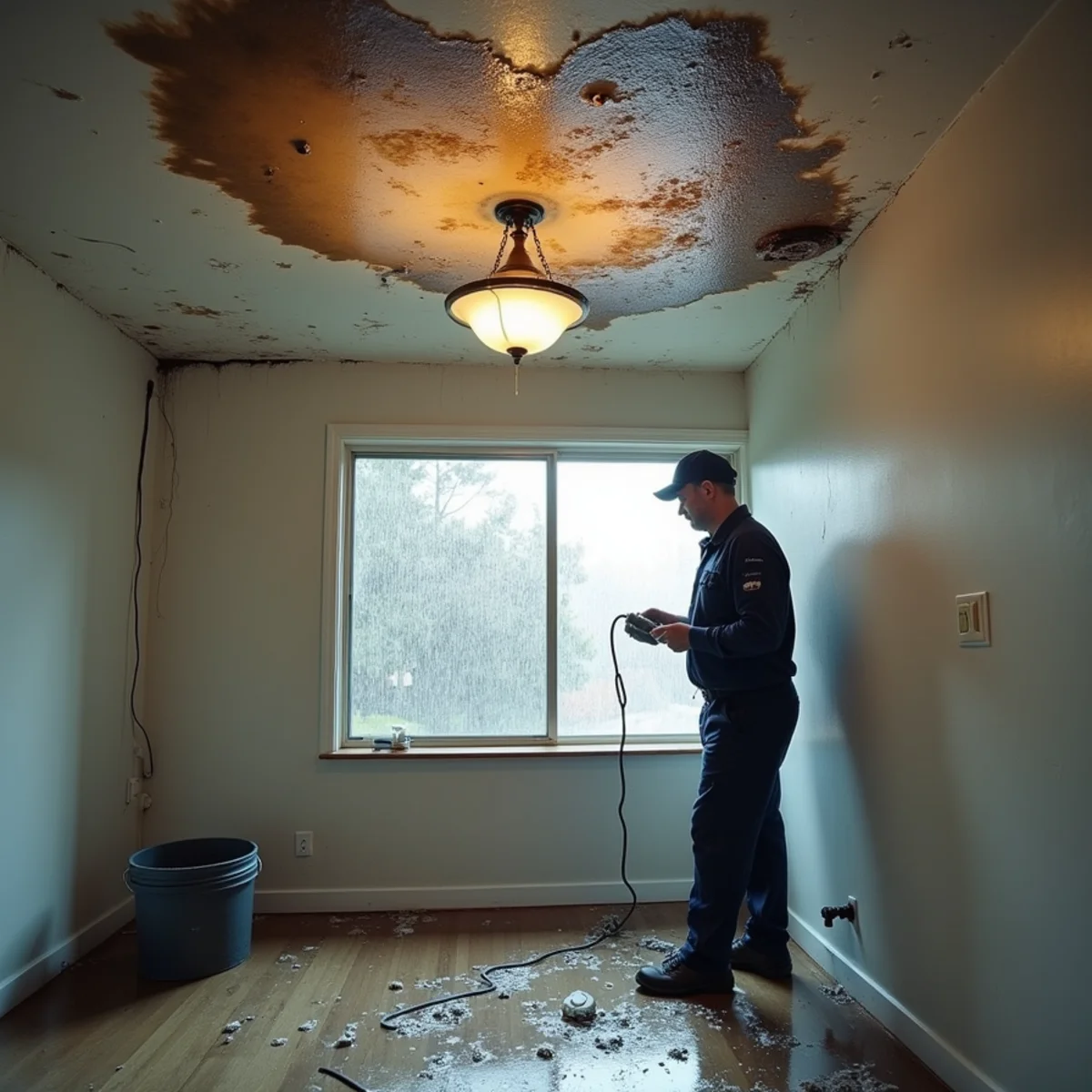
Put a bucket underneath. Then, with a screwdriver or similar, make a small hole at the lowest point of the bulge and let it drain into the bucket. One small hole, at the low point, so water runs to it rather than spreading across the ceiling.
If the bulge is large or the ceiling is already cracked around it, do not do this — the material may not survive being touched. Clear the area, put down protection, and let it come down on its own rather than being under it when it does.
Third: Contain and Document
Buckets, towels and plastic sheeting on the floor. Move furniture out rather than covering it — plastic over a sofa in a room with active dripping just holds water against the upholstery.
Then photograph everything: the ceiling, the staining, the drip pattern, the affected floor and contents, and the weather outside. Video the room and say out loud when it started and what the storm was doing.
Storm claims turn heavily on whether damage came from a storm-created opening — usually covered — or from a roof that had been failing from age and deferred maintenance — usually not. Photographs dated to the storm are the strongest evidence you can have.
Fourth: Do Not Go Onto the Roof
Not during the storm, not immediately after, not to have a quick look.
A wet roof of any pitch is unsafe, tile is unsafe when wet even for people who do this professionally, and a roof that has just failed may have compromised decking under the covering. Emergency tarping is genuinely dangerous work and it is done with fall protection by people who do it constantly.
What you can safely do from the ground is look for the obvious — missing or slipped tiles, a limb on the roof, a visibly displaced section — and photograph it with a zoom.
Why the Leak Is Not Above the Stain
Water entering at the roof deck runs downhill along the underside of the sheathing until it reaches a rafter, runs along that, and then drops at the first penetration or low point it finds.
On a low-slope plane, that regularly puts the interior stain fifteen or twenty feet from the actual entry, sometimes on the other side of the room. It is why patching the roof directly above a stain so often fails to stop the leak.
Proper diagnosis works uphill from the interior staining, tracing wet framing in the attic back to the entry point. That is what we do before any roof leak water damage restoration work begins.
Whittier Roofs and the November Problem
This city gets roughly 14 inches of rain a year, and nearly all of it falls between November and March. For eight months a roof is not tested at all.
A cracked tile or a lifted flashing sheds a light shower without complaint. Give it seventy-two hours of continuous rain against aging underlayment and the same defect becomes an active leak. Add Santa Ana wind events that lift material and drive rain horizontally under laps designed for water falling straight down, and you have the reason nearly every roof call we take clusters in the same few weeks.
The underlayment is the part homeowners underestimate. Visible tile can look sound at forty years old while the felt beneath it has gone brittle and stopped functioning — which is why the leak appears to come from nowhere.
How a Roof Leak Is Actually Traced
Diagnosis on these jobs runs backwards, from the interior stain to the entry, and almost all of the useful work happens in the attic rather than on the roof. Water entering at a damaged tile or a lifted flashing lands on the underside of the sheathing and runs downhill until something interrupts it — a rafter, a truss chord, a nail line — then travels along that member until it finds a low point and drips.
So the attic gets inspected with a strong light and a moisture meter, following wet or stained framing uphill from directly above the interior damage. Thermal imaging helps on a cold night because wet framing holds a different surface temperature than dry framing beside it, but it is a pointing tool rather than proof; every thermal indication gets confirmed with a meter reading before anyone acts on it.
The honest tradeoff on a storm leak is that permanent repair usually cannot happen during the storm. What can happen immediately is containment, extraction and drying inside, plus a temporary cover on the roof once conditions are safe. Homeowners are sometimes told to wait and have the whole thing dealt with at once. That is the wrong sequence — interior drying is time-critical and roof weather is not something anyone controls.
The bottom line
Clear the room, kill the circuit, relieve the bulge at its low point, document everything, stay off the roof.
Then get the attic looked at — because what is above the ceiling determines whether the repair holds or you are back here next November.